

Hospital bed weight capacity is model-specific and should be confirmed from the manufacturer’s safe working load and maximum patient-weight specifications. Safe working load commonly includes the patient, mattress and accessories or equipment supported by the bed, while maximum patient weight may be a lower figure. Buyers should never assume that these terms are interchangeable or calculate bed capacity by adding the ratings of individual components.
This guide explains how hospitals, nursing homes, distributors and medical equipment importers should compare load specifications, plan bariatric configurations and prepare an accurate RFQ.

Hospital Bed Weight-Capacity Terms Compared
| Term | What it usually describes | Common mistake | Buyer action |
|---|---|---|---|
| Safe working load (SWL) | Total permitted working load under the manufacturer’s stated conditions; commonly includes patient, mattress and supported accessories | Treating it as patient weight alone | Request the model definition and included-load statement |
| Maximum patient weight | Maximum permitted patient weight for the specified configuration | Assuming it equals SWL | Record it separately from mattress and accessory allowance |
| Static test load | A load used in a defined test procedure | Using a test value as the operating capacity | Do not use it unless the manufacturer identifies it as an operating limit |
| Component rating | Rating for a caster, actuator, lifting pole or another part | Adding component ratings to create a bed rating | Use the complete-bed specification |
| Scale capacity | Measuring range of an optional integrated weighing system | Assuming scale capacity equals bed SWL | Compare both values and their conditions |
| Product weight | Weight of the empty bed in a stated configuration | Confusing bed weight with load capacity | Use it for transport, floor and logistics planning |
The supplier’s operating manual and model specification control the interpretation. If a quotation lists only “capacity” without defining the term, ask for clarification before comparing prices.
What Does Safe Working Load Include?
For many hospital bed models, safe working load is the total of the patient, mattress and accessories or equipment carried by the bed. Manufacturers may define the included items more precisely, so procurement teams should request the actual model wording.
Potential supported loads can include:
- The patient
- The mattress or powered therapeutic surface
- Bed-mounted accessories
- Equipment placed on approved shelves or holders
- Items supported by approved lifting or helper components
- Any other load the manufacturer identifies in its instructions
Do not create a universal calculation such as “SWL minus mattress equals patient capacity” unless the manufacturer confirms that approach for the exact configuration. Some accessories have their own load limits, mounting restrictions and effects on the overall system.
Also distinguish between a load supported by the bed and equipment standing independently on the floor. An overbed table, for example, may roll around the bed without adding its full weight to the platform, while a bed-mounted monitor shelf does add load through its attachment.
Capacity Considerations by Hospital Bed Type
Manual ward beds
Manual beds may have a simpler frame and fewer powered components, but their capacity still depends on the complete design. Ask whether the rating applies with the platform flat and articulated, and confirm crank, deck, caster and rail compatibility.
Electric hospital beds
Electric beds rely on actuators, joints and controls to move a loaded platform. The published load does not mean every motor can perform every movement under any condition. Follow the manufacturer’s operating limits, duty cycle and instructions. The quotation should identify the load rating for the exact motor and frame configuration.
ICU beds
ICU beds may carry powered surfaces, integrated controls, batteries and multiple accessories. Ask for both bed SWL and maximum patient weight, plus any separate limits for scales, shelves, IV poles and other mounted components. Use the ICU bed specifications buying guide for the wider tender checklist.
Nursing and home-care beds
These beds need to match the intended user group, mattress, transfer method and home or facility environment. A higher headline capacity does not replace assessment of width, height, rails and caregiver workflow. Home-care distributors should give users the correct model instructions rather than presenting one weight figure without context.
Pediatric beds
Pediatric beds are chosen for a defined patient group and have model-specific enclosure, mattress and load requirements. Adult bed assumptions should not be transferred to pediatric equipment.
Bariatric Hospital Bed Capacity and Selection
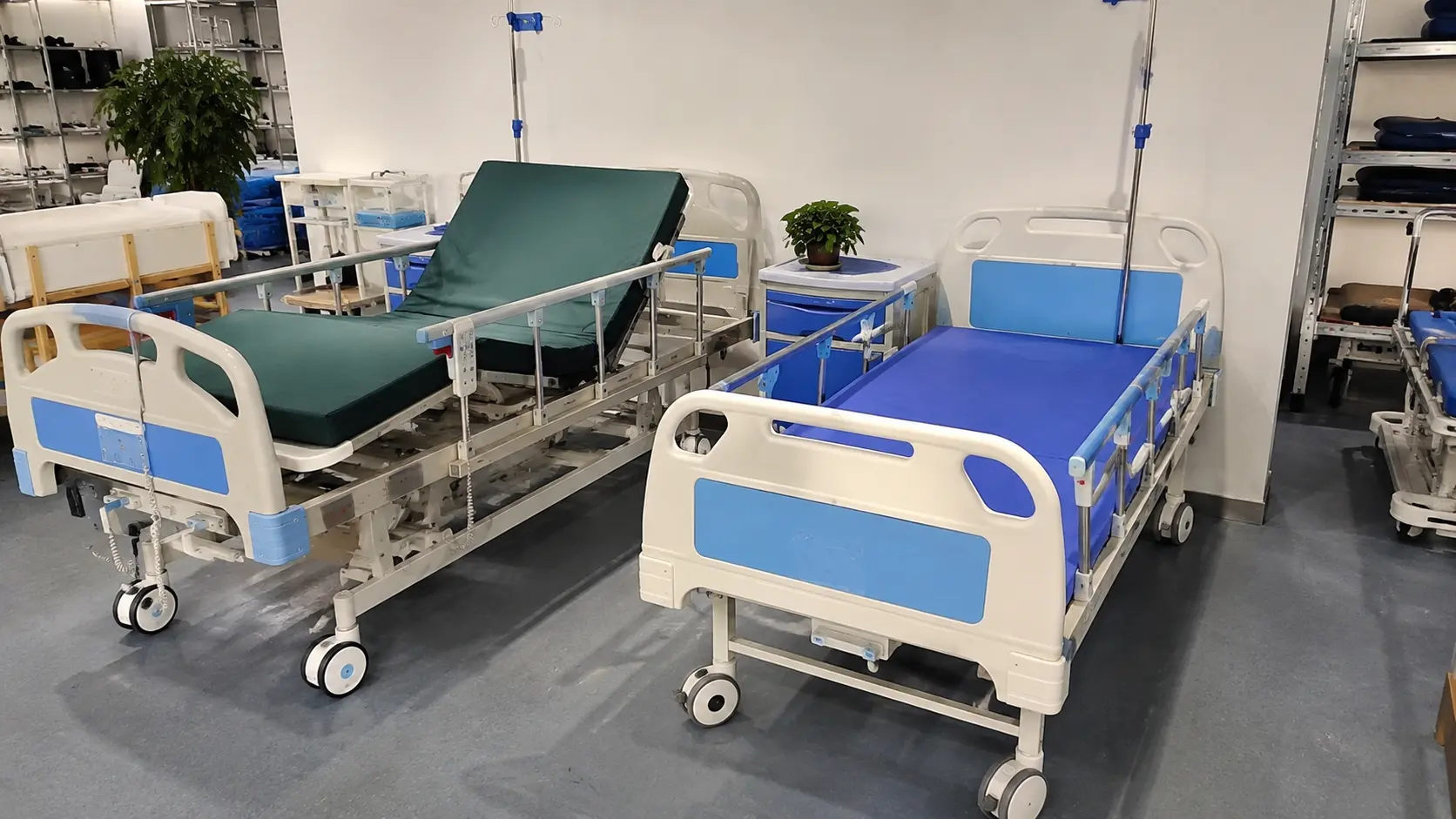
A bariatric bed is not simply a standard bed with a wider mattress. It is a complete higher-load configuration that may use a wider or expandable platform, reinforced frame, suitable actuators, larger or specially rated casters, compatible rails and a matching mattress.
Buyers should confirm:
- Safe working load
- Maximum patient weight
- Standard and expanded platform widths
- Overall width with rails and bumpers
- Mattress dimensions and surface capacity
- Capacity of lifting poles, scales and mounted accessories
- Load conditions during height, backrest and tilt movements
- Door, elevator and turning clearance
- Product weight and transport requirements
Wider beds also affect room access and staff movement. A technically adequate load rating is not enough if the bed cannot pass through facility doors or fit the elevator. Review hospital bed dimensions before approving a bariatric model.
Which Components Affect the Complete-Bed Rating?
Frame and platform
Frame sections, welds, joints, platform panels and retaining structures distribute load through the bed. Buyers should not judge strength from tube appearance or steel thickness alone. Request the complete product rating and relevant model-level documentation.
Actuators and linkages
Electric and mechanical movement systems work under load. The manufacturer selects actuators, crank assemblies, pivots and linkages as a system. Replacing a motor with a visually similar component does not automatically preserve the bed’s rating or movement limits.
Casters and brakes
Casters carry the bed and supported load, but individual caster ratings cannot be multiplied to establish the complete-bed capacity. Load distribution changes during movement and when the deck is articulated. See the hospital bed casters guide for mounting, braking and replacement checks.
Mattress and support surface
The mattress has its own intended use and capacity. A bed frame may support a load that the selected surface is not designed to accommodate. Width, thickness, compression and rail compatibility must also be confirmed.
Side rails and accessories
Side rails, lifting poles, IV poles, monitor shelves and other components may have individual restrictions. They should not be used as lifting or load-bearing points unless the manufacturer specifically identifies that purpose.
Extensions, Accessories and Configuration Changes
Ask whether the load specification changes when a bed is extended, widened or fitted with options. A manufacturer may define one rating for the base model and different conditions for an extended platform, integrated scale, powered transport or other configuration.
| Configuration change | Possible effect to verify | Evidence to request |
|---|---|---|
| Length extension | Deck support, mattress section and rail coverage | Extended-model specification and instructions |
| Width expansion | Platform, mattress, rails, caster loading and room access | Approved width modes and capacity statement |
| Powered air surface | Additional weight, fit and power requirements | Bed-and-surface compatibility confirmation |
| Patient lifting pole | Separate pole load and mounting limitation | Accessory rating and compatible-bed list |
| Monitor or oxygen holder | Supported accessory load and bed balance | Approved mounting position and load limit |
| Replacement casters | Load, overall height, braking and steering | Correct part number or written compatibility |
Do not add aftermarket accessories, homemade extensions or unapproved components to increase capacity. Any modification needs manufacturer review and the facility’s applicable approval process.
How Buyers Should Verify Hospital Bed Capacity
- Identify the exact model. Record manufacturer, model, version and all relevant options.
- Request both load figures. Ask for safe working load and maximum patient weight as separate fields.
- Obtain the definition. Confirm which mattress, accessories and equipment are included in SWL.
- Check the configuration. Make sure width extensions, powered surfaces, scales and accessories match the stated rating.
- Review movement conditions. Ask whether the rating applies through all permitted bed functions and positions.
- Confirm component limits. Record separate ratings for poles, shelves, scales and other accessories.
- Check labels and manuals. The delivered bed should carry model-consistent identification and instructions.
- Approve a sample. Inspect the complete configuration before volume production.
- Train local staff. Use the manufacturer’s operating and maintenance information for the delivered model.
The hospital bed specifications checklist can be used to combine capacity with functions, dimensions, electrical details and accessories in one comparison sheet.
Hospital Bed Capacity Procurement Scenarios
Scenario 1: General ward tender
The hospital states its required patient profile and total system requirement. Suppliers return SWL, maximum patient weight, bed weight and mattress weight in separate columns. The tender committee rejects undefined “capacity” figures that cannot be compared.
Scenario 2: Bariatric-bed purchase
The buyer evaluates load, usable width and movement together. Doorways, elevators and turning areas are measured using overall dimensions. The mattress, rails, scale and lifting accessories are checked against the expanded configuration.
Scenario 3: Nursing-home standardization
The group selects a standard model for most residents and a smaller number of higher-capacity beds for defined needs. Staff receive clear instructions so higher-capacity labels do not lead to unsuitable mattress or accessory substitutions.
Scenario 4: Replacement mattress or accessory
The facility checks whether the new item changes the load allowance, fit or rail relationship. It records the supplier’s compatibility confirmation with the bed asset number rather than relying on a generic product description.
Hospital Bed Weight Capacity RFQ Checklist
- Facility type and bed application
- Bed category, model and quantity
- Required safe working load
- Required maximum patient weight
- Manufacturer’s definition of included SWL loads
- Mattress model, weight, size and capacity
- Required accessories and their individual limits
- Standard, extended or expanded bed configuration
- Overall and platform dimensions
- Bed product weight
- Movement and position conditions under load
- Caster, brake and steering configuration
- Scale capacity and accuracy if required
- Labels, instructions and model-level documents
- Destination country, port, lead time and inspection plan
Haoshangjia Medical supplies hospital bed configurations for hospitals, nursing homes, clinics, rehabilitation centers and medical equipment distributors. Capacity, dimensions, accessories and documentation should be confirmed for the exact model before order.
Hospital Bed Weight Capacity FAQ
What is the typical hospital bed weight capacity?
There is no universal capacity. Standard ward, ICU, nursing, home-care and bariatric models differ substantially. Use the exact model’s safe working load and maximum patient-weight specifications.
Is safe working load the same as maximum patient weight?
Usually not. SWL commonly includes the patient, mattress and supported accessories, while maximum patient weight applies to the patient. Confirm the manufacturer’s definitions.
Can I calculate patient capacity by subtracting mattress weight from SWL?
Only if the manufacturer confirms that calculation for the exact model and configuration. Accessories, equipment and other conditions may also be included.
Does a wider bed always have a higher capacity?
No. Width and load rating are separate specifications. A wider platform does not prove that the frame, actuators, casters and accessories have a higher rating.
Can higher-rated casters increase the bed’s capacity?
No. Replacing one component does not establish a higher complete-bed rating. Capacity depends on the entire manufacturer-approved system.
What should buyers check on a bariatric bed?
Check SWL, maximum patient weight, usable and overall width, mattress, rails, casters, functions, accessories, product weight and facility access.
Request a Model-Specific Load Configuration
Send Haoshangjia Medical the bed type, quantity, required SWL, patient-weight requirement, mattress, accessories, dimensions, destination country and documentation needs. We can organize a model-specific quotation for review.