
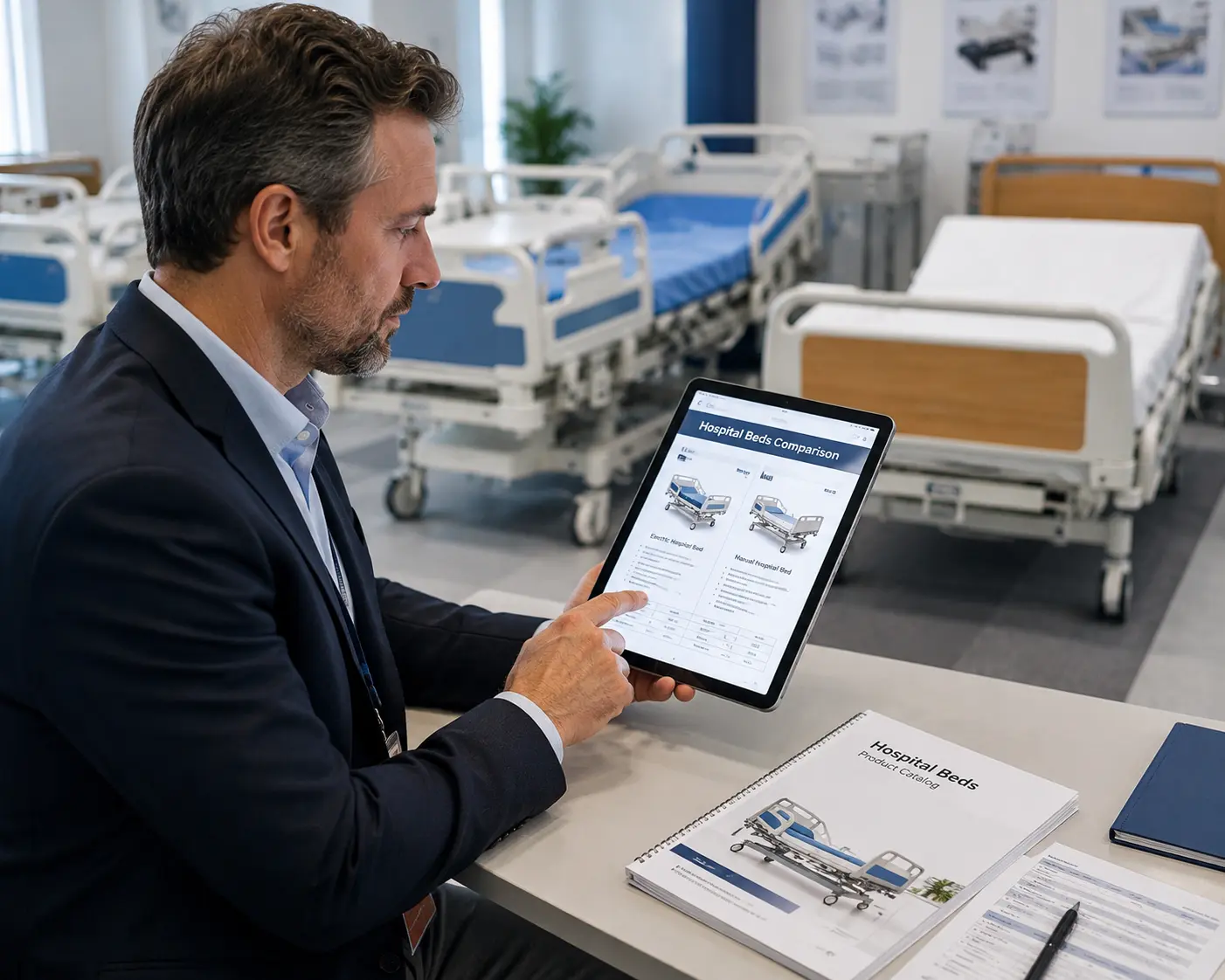
The main hospital bed functions are backrest adjustment, knee or leg-rest adjustment, height adjustment, Trendelenburg and reverse Trendelenburg positioning. Depending on the bed type, additional functions may include CPR release, cardiac-chair positioning, bed extension, central braking, directional steering, patient controls, nurse lockouts and battery backup. Buyers should specify each required movement and operating method instead of relying only on labels such as “three-function” or “five-function.”
This guide explains what common functions mean, which bed categories usually offer them and how hospitals, nursing homes, distributors and importers should document them in an RFQ.
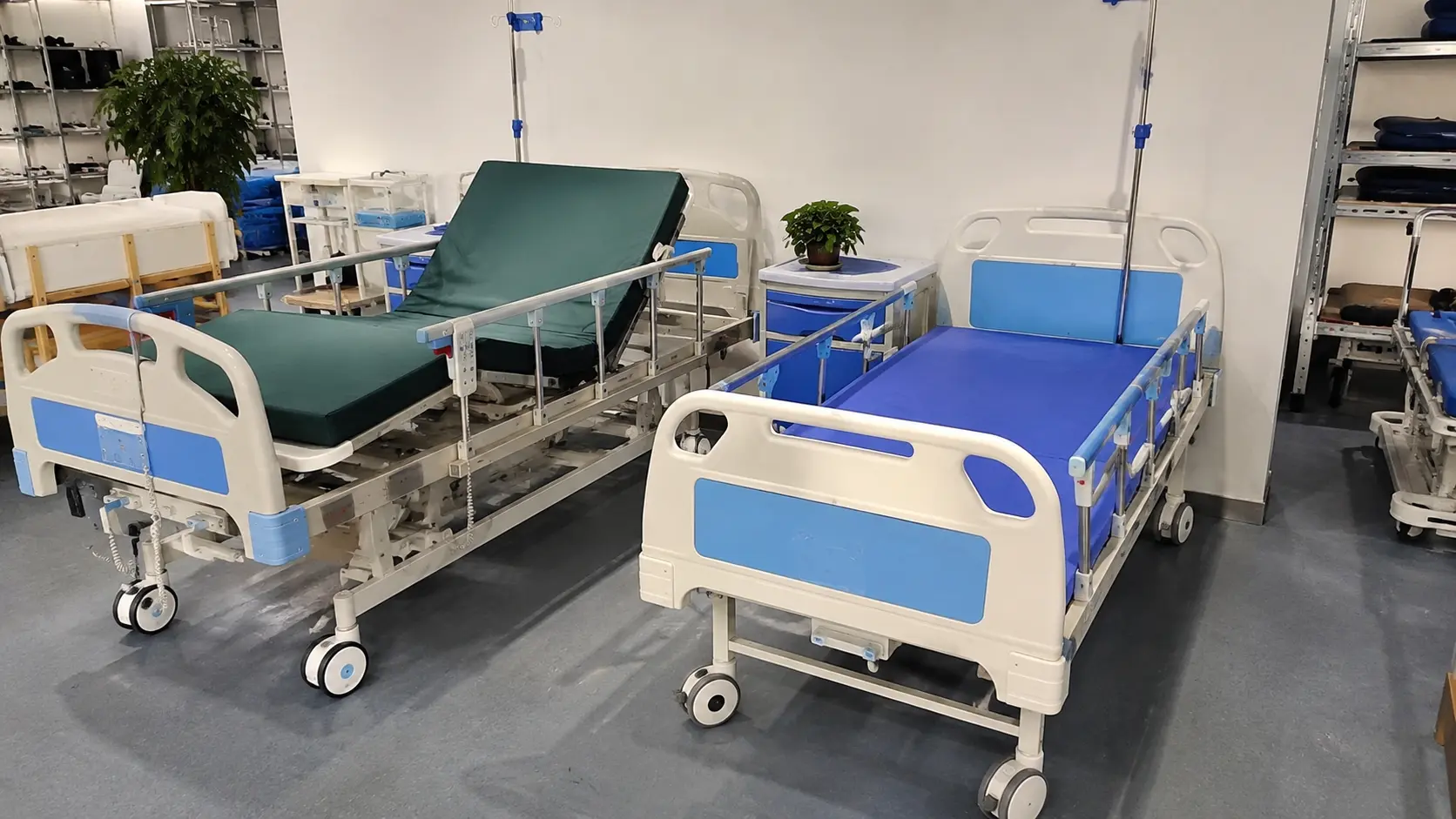
Hospital Bed Function Comparison
| Function | What moves or changes | Typical operating method | Buyer must confirm |
|---|---|---|---|
| Backrest adjustment | Raises or lowers the upper platform | Crank or electric actuator | Angle range, control location and mattress articulation |
| Knee or leg-rest adjustment | Raises or profiles the lower platform | Crank, ratchet or electric actuator | Exact deck section and whether leg elevation is independent |
| Height adjustment | Raises or lowers the entire mattress platform | Crank, hydraulic or electric system | Minimum and maximum height with the specified casters |
| Trendelenburg | Tilts the deck with the head end lower than the foot end | Electric, hydraulic or mechanical, model-specific | Angle, control access and intended bed category |
| Reverse Trendelenburg | Tilts the deck with the head end higher than the foot end | Electric, hydraulic or mechanical, model-specific | Angle and whether it is counted separately |
| CPR release | Returns relevant deck sections toward a flat position | Manual release or electric control | Which sections move, release locations and instructions |
| Cardiac-chair position | Combines several movements into a chair-like profile | Preset or coordinated electric movement | Actual deck geometry and control sequence |
| Bed extension | Adds usable platform length | Manual or integrated mechanism | Extended dimensions, mattress section and rail coverage |
| Central braking | Operates multiple caster brakes from linked pedals | Foot pedal or control bar | Brake, neutral and steering modes |
| Battery backup | Supports specified powered operations without mains supply | Rechargeable battery system | Supported functions, use conditions and maintenance |
The table provides a vocabulary for comparison. It does not mean every model offers every function or that the same name produces an identical movement across manufacturers. Request an exact specification sheet and operating demonstration for the quoted bed.
Core Hospital Bed Platform Adjustments
Backrest adjustment
Backrest adjustment changes the angle of the upper mattress-platform section. It is one of the most common functions on manual, electric, nursing and home-care beds. Buyers should request the stated adjustment range and confirm whether the angle indicator, if offered, is mechanical, electronic or integrated into a side rail.
The mattress must bend correctly with the deck without excessive shifting or bunching. Side-rail clearance, patient handset cables and accessories should be checked throughout the movement.
Knee-rest and leg-rest adjustment
Terminology is inconsistent. One supplier may describe a lower-deck movement as knee-rest adjustment, while another may call it leg elevation. Some beds coordinate knee and foot sections; others provide a ratchet or separate adjustment. The buyer should ask for a diagram showing exactly which sections move and whether each movement is powered.
Height adjustment
Height adjustment raises or lowers the whole platform. Procurement teams should record both minimum and maximum height and the measurement reference—such as the top of the platform without a mattress. Mattress thickness and caster size change the final working and transfer height.
A quoted low minimum height does not by itself establish suitability for an individual. Local care teams must evaluate transfers, staff workflow, the mattress and facility procedures.

Trendelenburg and Reverse Trendelenburg Functions
Trendelenburg tilts the mattress platform so the head end is lower than the foot end. Reverse Trendelenburg tilts it in the opposite direction. These movements are more commonly associated with multi-function electric and ICU beds than with basic ward beds.
Buyers should not infer clinical use from the name alone. The facility defines when and how a position is used according to local procedures and qualified clinical judgment. The procurement specification should focus on the available movement, angle, control location, lockout and return method.
Ask whether the two tilt directions are counted as one function or two. Also confirm whether the platform tilts as a whole and whether height changes during the sequence. If angle indicators are required, state their locations and required display format.
Critical-Care and Emergency Functions
CPR release
A CPR release is intended to return relevant articulated sections toward a flat configuration, but designs vary. A manual lever may release the backrest quickly, while an electric CPR control may coordinate more than one actuator. Ask the supplier to describe the exact sequence, release locations, power requirements and reset procedure.
Do not accept “CPR function” as a complete specification. Verify the operating instructions on a sample bed and ensure training materials match the delivered model.
Cardiac-chair or chair position
A chair-like position typically combines backrest elevation, knee profiling and tilt or deck movement. Some beds reach it through a preset button; others require several separate controls. Compare the final geometry and movement sequence rather than the marketing name.
One-button positions and presets
Advanced electric beds may provide preset controls for selected positions or movements. Buyers should state which presets are mandatory, who can activate them and which lockouts apply. The quotation should distinguish a true preset from a printed icon that requires manual coordination of several buttons.
Bed extension
An extension increases usable deck length for a specified configuration. Confirm the standard and extended platform dimensions, complete bed length, mattress extension method and any change in side-rail coverage or load conditions. See the hospital bed dimensions guide for room and access planning.
Mobility, Braking and Steering Functions
Mobility features are sometimes left outside the function count, but they materially affect staff workflow. Basic beds may use individual caster brakes. More advanced models may use central-locking pedals with brake, neutral and directional modes.
A directional caster helps a bed track during straight corridor movement. Fifth-wheel systems or other steering arrangements may be available on selected designs. Test maneuvering through doors, elevators and turns using the intended bed and accessory configuration.
The hospital bed casters guide explains wheel size, central braking, directional steering and replacement compatibility in more detail.
Controls, Lockouts and Electrical Functions
Patient handset
A handset gives access to specified electric movements. Confirm button layout, icons or labels, cable length, storage hook and whether the handset can be replaced independently. For export orders, specify required language and destination-market electrical details.
Nurse controls and lockouts
A nurse panel or integrated rail control may operate additional functions or disable selected patient controls. The RFQ should list which movements require lockout and whether status is shown by lights, symbols or a display.
Battery backup
A battery does not necessarily power every function for unlimited operation. Ask which movements are supported, under what conditions, and how charging, storage, inspection and replacement are handled. Record the battery model as a spare part where appropriate.
Manual or emergency release
Some powered systems include a manual release or another procedure for power interruption. The supplier should explain what the procedure does, who may perform it and what inspection is needed afterward. Avoid assuming that every electric bed behaves the same way.
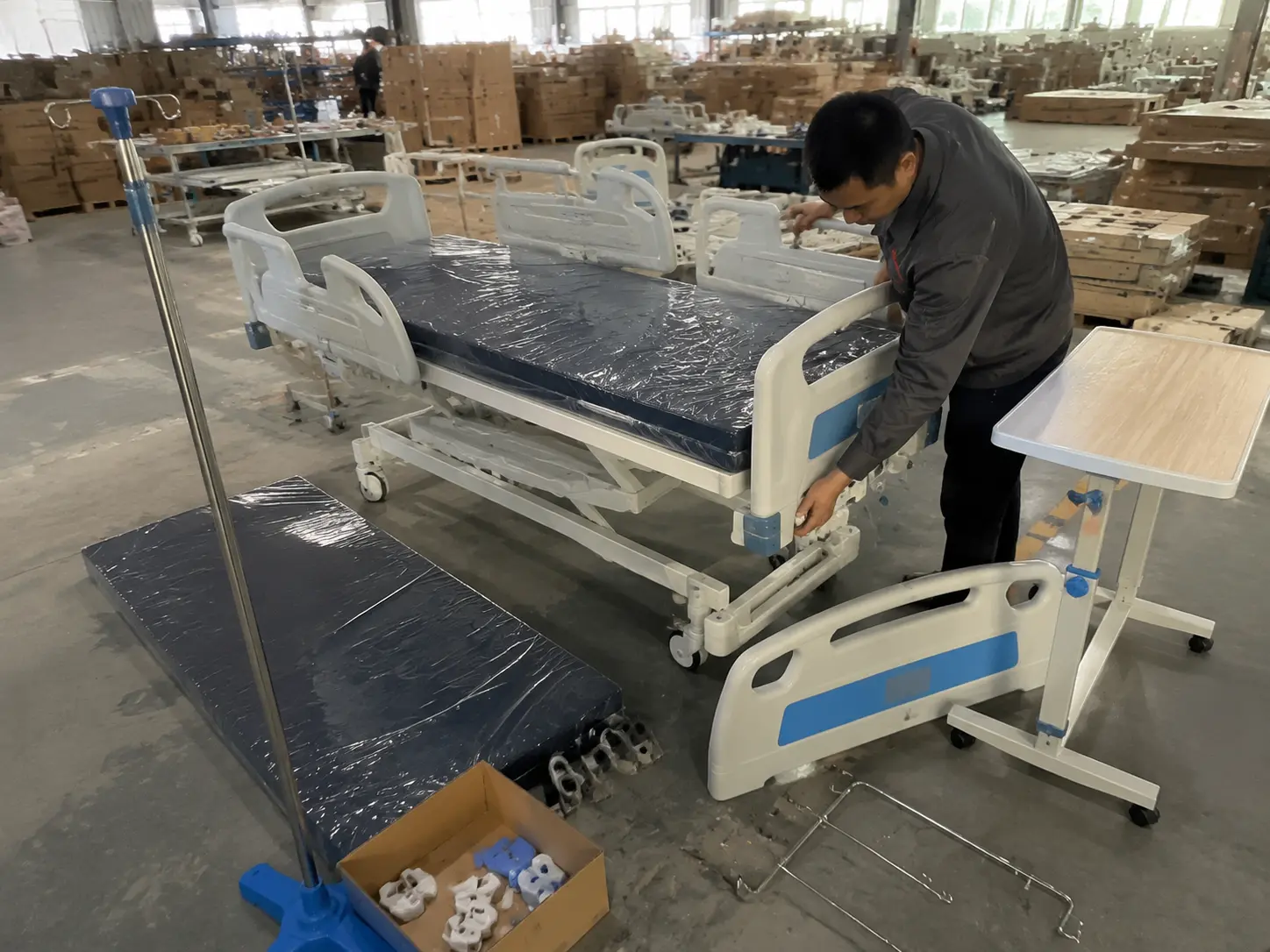
Why Three-Function and Five-Function Labels Vary
There is no reliable assumption that every supplier counts functions identically. One three-function bed may list backrest, knee-rest and height. Another quotation may describe deck movements differently. A five-function bed often adds two tilt directions, but buyers must confirm this rather than infer it.
| Weak RFQ wording | Better RFQ wording |
|---|---|
| Three-function electric bed | Electric backrest, electric knee-rest and electric height, with ranges stated |
| Five-function ICU bed | List all five required movements and the control method for each |
| CPR function required | State manual/electric requirement, controlled sections and release locations |
| Battery included | State supported functions, quantity, model and required documentation |
| Central brake | State pedal positions and required brake, neutral and steering modes |
For a focused comparison of common electric configurations, read 3 function vs 5 function electric hospital bed.
Which Functions Belong to Which Bed Type?
Manual hospital beds
Manual models usually provide backrest, lower-deck and sometimes height adjustment through cranks. They may suit settings with limited electrical infrastructure or lower adjustment frequency. Staff workload and crank access should be included in the decision.
Electric ward beds
Electric beds make common adjustments available through powered controls. Buyers may choose basic profiling and height or add tilt, nurse controls and central braking. More functions increase the need for electrical service, training and spare components.
ICU beds
ICU models may combine multi-motor positioning, CPR release, preset positions, integrated controls, central braking, steering and battery support. Select only functions justified by the tender and care workflow. Our ICU bed specifications buying guide provides a complete technical checklist.
Nursing and home-care beds
These beds may prioritize low height, simple controls, back and knee profiling and caregiver access. The right configuration depends on the user group, transfers, room, power and service support. Function count alone should not decide suitability.
Hospital Bed Function Procurement Scenarios
Scenario 1: General ward replacement
The hospital requires frequent height and backrest changes but does not need advanced presets on every bed. It specifies electric backrest, knee-rest and height, central braking and a battery option. Tilt is listed only for selected departments, avoiding unnecessary cost across the whole project.
Scenario 2: ICU tender
The buyer creates a movement schedule with required ranges, controls and lockouts. CPR release and chair positioning are demonstrated during sample evaluation. The team records which features are standard, optional or unavailable rather than comparing a headline function count.
Scenario 3: Nursing-home standardization
The group selects a consistent electric platform with simple handset controls and low-height capability. It avoids extra presets that staff will not use, then standardizes mattresses, rails, casters and spare handsets across locations.
Scenario 4: Distributor product range
The distributor offers a manual value model, a basic electric model and an advanced option. Each has a fixed function table and compatible accessory list. Clear differentiation reduces quoting errors and makes after-sales parts easier to manage.
Hospital Bed Functions RFQ Checklist
- Facility type, department and intended bed category
- Quantity by model and function configuration
- Backrest movement and required range
- Knee-rest, leg-rest or foot-section movement and range
- Minimum and maximum platform height
- Trendelenburg and reverse Trendelenburg requirements
- CPR release type, controlled sections and release locations
- Preset or chair-position requirements
- Bed extension and mattress-extension requirement
- Patient handset, nurse panel and lockout functions
- Battery-supported functions and power-interruption procedure
- Caster brake and directional steering modes
- Mattress, side rails and required accessories
- Voltage, frequency, plug and control-label language
- Destination country, documentation, quantity and lead time
Haoshangjia Medical supplies hospital bed configurations for hospitals, nursing homes, clinics, rehabilitation centers and medical equipment distributors. Functions, ranges, controls and documentation should be confirmed for each quoted model.
Hospital Bed Functions FAQ
What are the basic hospital bed functions?
Common basic functions are backrest adjustment, knee or leg-rest adjustment and height adjustment. The exact combination and operating method vary by bed model.
What are the five functions of a hospital bed?
A common configuration includes backrest, knee-rest, height, Trendelenburg and reverse Trendelenburg. Suppliers may count differently, so all movements should be listed individually.
Is a full-electric bed the same as a five-function bed?
No. Full-electric describes how main adjustments are powered, while five-function describes a claimed number of movements. A full-electric model may have a different function count.
What does the CPR function do?
It returns specified articulated sections toward a flat configuration through a manual release, electric control or model-specific sequence. Buyers must verify exactly which sections move.
Does battery backup operate every bed function?
Not necessarily. Supported operations and duration depend on the model, battery and conditions. Request written details and maintenance instructions.
Should buyers choose the bed with the most functions?
No. Select functions that match the department, staff workflow, patient group, maintenance resources and budget. Unused features add cost and service complexity.
Request a Function-by-Function Hospital Bed Quotation
Send Haoshangjia Medical your facility type, bed quantities, required movements, ranges, voltage, mattress, rails, casters, accessories, destination country and documentation needs. We can prepare a model-specific comparison without relying on ambiguous function-count labels.