
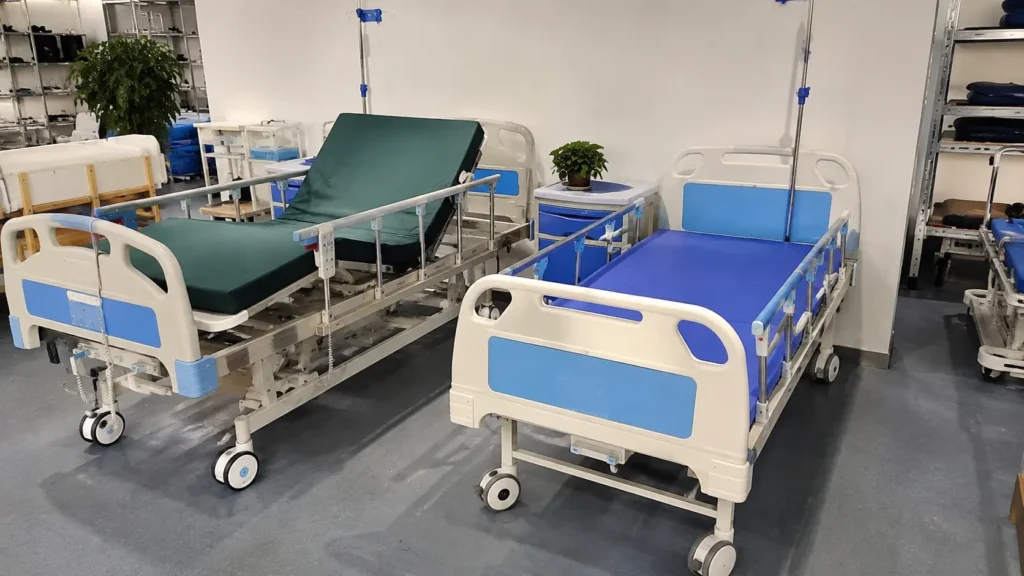
The right home care hospital bed must fit the user’s care needs, the caregiver’s routine, and the physical limits of the home. Before ordering, buyers should confirm required adjustments, minimum and maximum height, mattress and side-rail compatibility, room access, electrical requirements, assembly, cleaning, service, and delivery responsibility. For distributors and importers, packaging, spare parts, documentation, OEM requirements, and local after-sales capability are equally important.
This home care hospital bed buying guide is for home medical equipment distributors, importers, care providers, rehabilitation projects, and procurement teams. It provides a practical framework for comparing models and preparing a complete RFQ without assuming that an institutional hospital bed will automatically suit a residential environment.
1. Define the User and Care Needs
Start with the care routine rather than a catalogue model. The buyer should establish whether the user can reposition independently, how often a caregiver assists, whether transfers involve a wheelchair or lifting device, and whether the bed is for short-term recovery or long-term support. The final selection should follow an appropriate local care assessment.
Ask these questions before requesting prices:
- Which positions must be adjusted during a normal day?
- Can the user operate a handset, or will a caregiver control the bed?
- Is adjustable height needed for transfers or caregiver access?
- Will a wheelchair, commode, hoist, or overbed table approach the bed?
- What mattress size and care-related mattress requirements apply?
- Are there unusual user-size or load requirements?
- Who will deliver, assemble, demonstrate, clean, and service the bed?
A distributor should convert these questions into a repeatable customer intake form. This helps sales teams recommend a suitable configuration and reduces returns caused by doorway problems, missing accessories, incorrect voltage, or misunderstood functions.
2. Choose the Required Functions
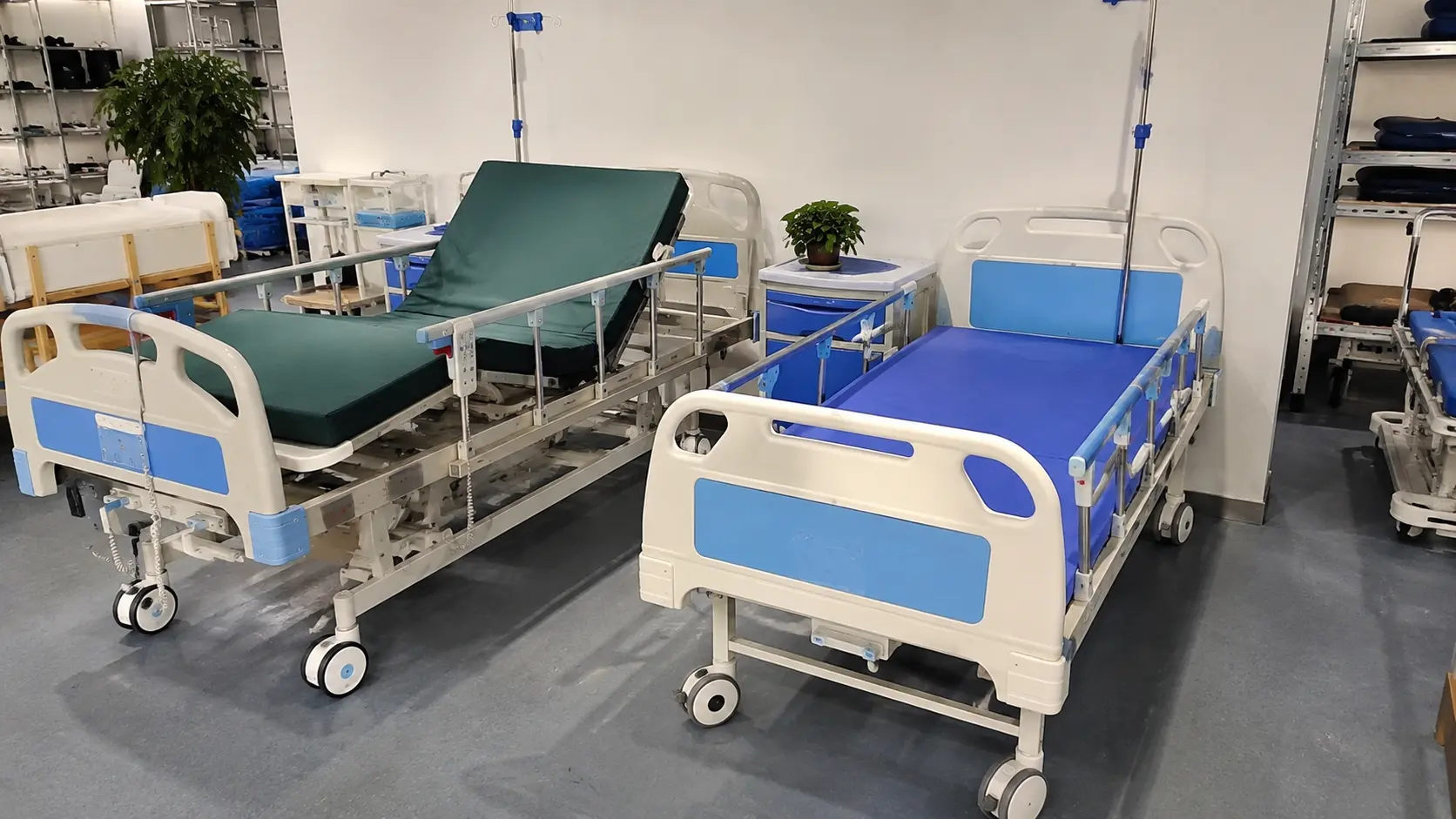
Backrest adjustment supports upright resting and daily activities. Leg or knee adjustment changes lower-body positioning. Overall height adjustment may help caregivers work at a suitable level and support certain transfer routines. Additional positions should be selected only when they solve a defined need and the intended users understand how to operate them.
Do not rely on labels such as “three-function” without a movement list. Function-count terminology varies. Ask for the adjustment range, control method, motor or actuator information, bed platform dimensions, overall dimensions, and the exact accessories included with the quoted model.
Electric beds are often practical when adjustments are frequent or when easier control is important. Manual beds may suit budget-controlled programs, lower adjustment frequency, or locations where simple maintenance and independence from mains electricity are priorities. The comparison in electric vs manual hospital bed explains the broader operational trade-offs.
3. Compare Home Care Hospital Bed Types
| Bed Type | Typical Use | Main Benefit | Buyer Checks |
|---|---|---|---|
| Basic manual care bed | Lower adjustment frequency and price-sensitive programs | Simple operation and maintenance | Crank access, included movements, parts availability |
| Electric adjustable home care bed | Regular positioning in private homes | Convenient handset adjustment | Voltage, plug, controls, cables, power interruption plan |
| Electric height-adjustable bed | Frequent caregiver assistance and planned transfers | More adaptable working and transfer height | Minimum/maximum height, stability, caster and brake design |
| Home-style medical bed | Residential or premium home-care channels | Softer visual fit for a bedroom | Finish durability, assembly, cleanability, service access |
| Nursing bed configuration | Long-term daily care with defined caregiver routines | Care-oriented functions and accessories | Difference from home model, rails, mattress, total footprint |
There is no universally best type. Compare the complete delivered system, not only the frame. A lower quotation may exclude the mattress, side rails, handset, headboard, accessories, installation, spare parts, or documentation. Buyers can review Haoshangjia Medical’s home care hospital bed range for model-based quotation support.
4. Measure the Home and Delivery Route
Residential delivery is one of the most common sources of preventable problems. Record both the mattress-platform dimensions and the bed’s maximum overall footprint. Include headboards, footboards, rails, bumpers, handles, and accessories. Confirm the space needed for adjustments and caregiver movement.
Measure the full delivery route:
- Building entrance, gates, and ramps
- Door width and height
- Corridor width and turning corners
- Elevator door, cabin, and load limit
- Stairs, landings, and handrail clearance
- Bedroom doorway and final assembly area
- Space beside the bed for transfers and daily care
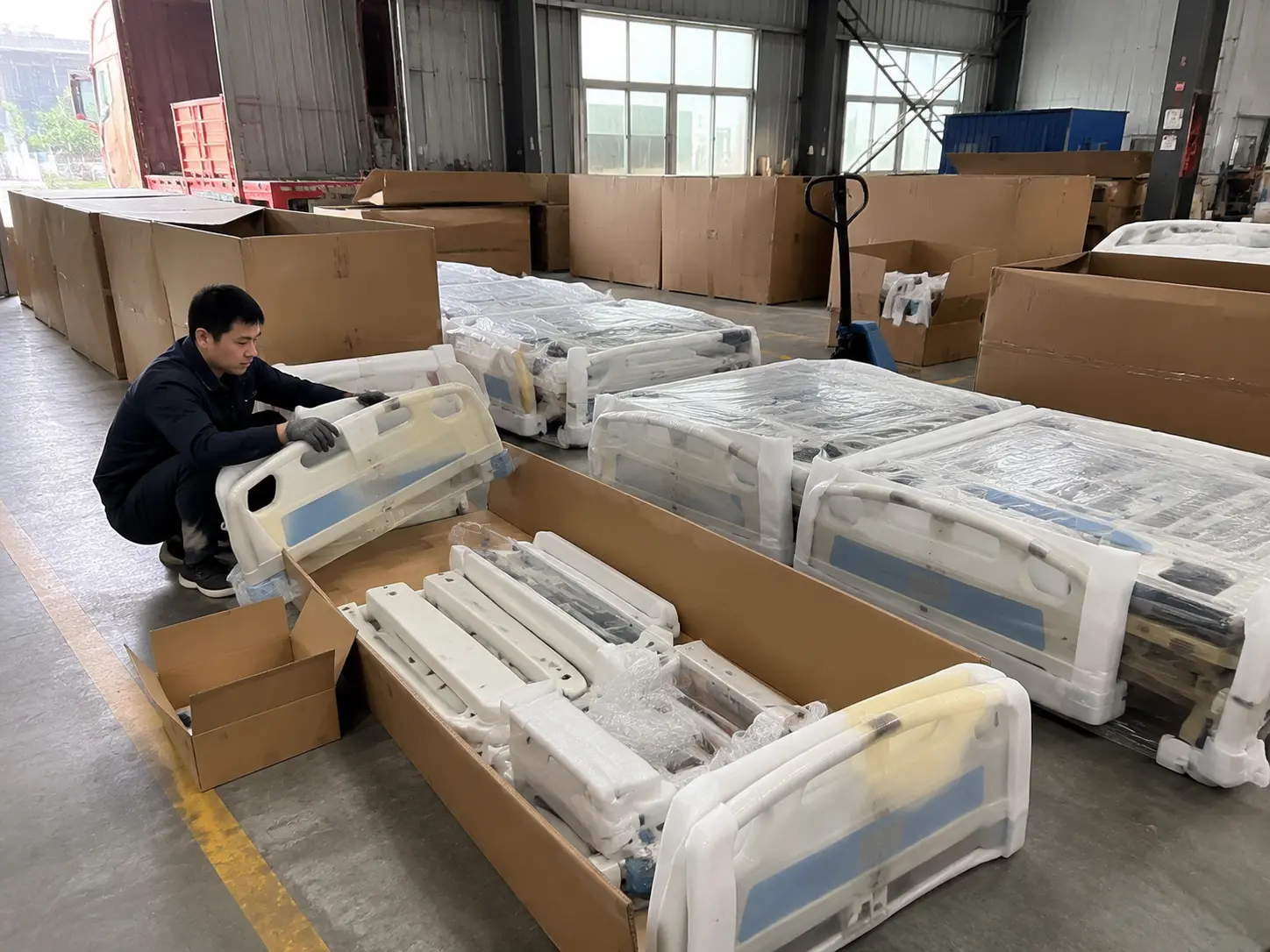
Ask whether the bed ships assembled, partly assembled, or in separate cartons. Confirm the heaviest and largest package, required tools, number of installers, estimated assembly time, and whether installation instructions or videos are available. For distribution programs, packaging must protect the product while remaining manageable for local delivery teams.
5. Check Mattress, Rails, Casters, and Accessories
Mattress compatibility
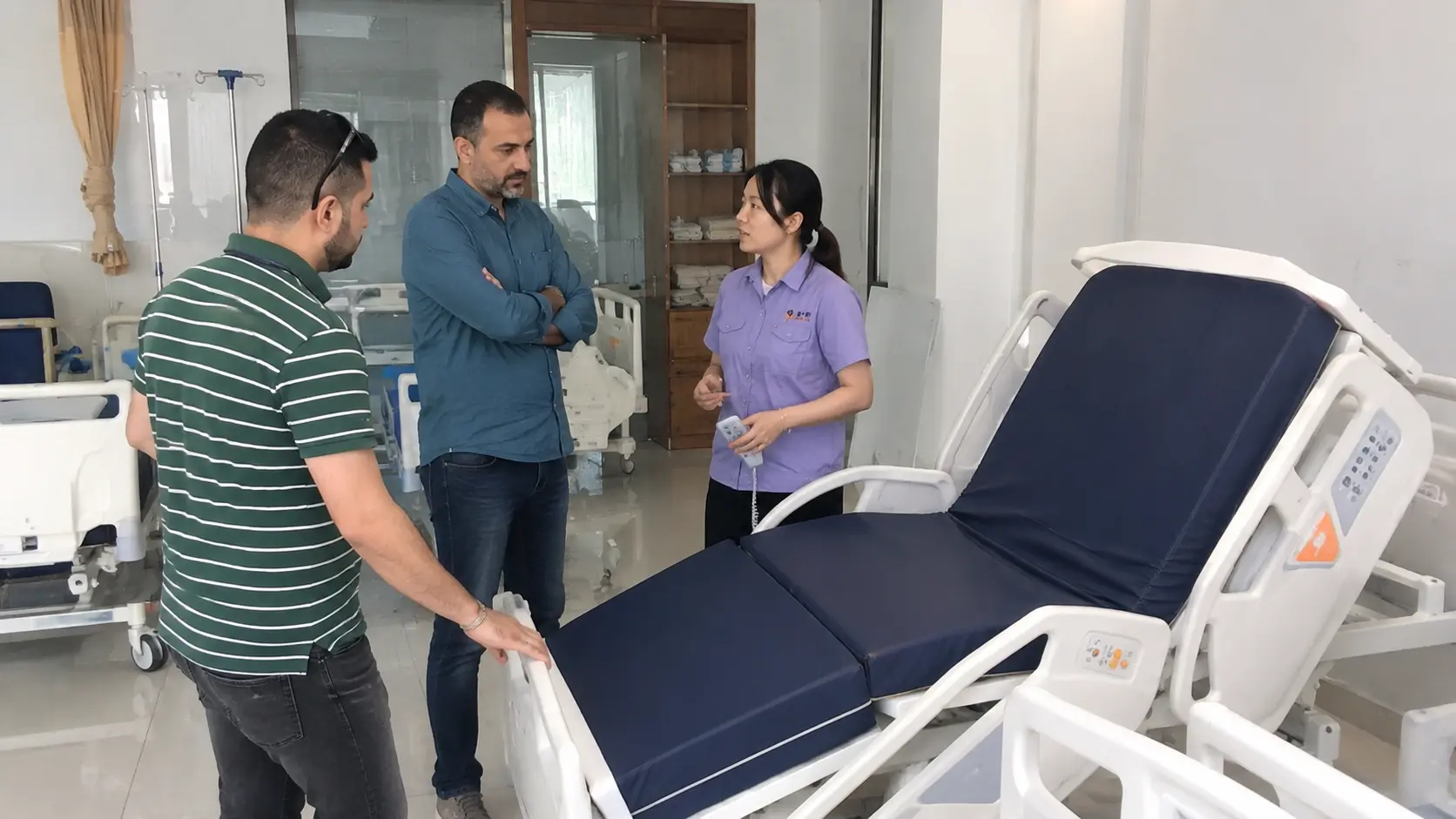
Specify the platform length and width, mattress dimensions, thickness, cover, cleanability, and any care-related performance required by the buyer’s local assessment. Mattress height affects the effective rail height and relevant gaps, so the bed, mattress, and rail must be evaluated together.
Side rails
Confirm rail type, length, movement, lock, release access, and compatibility with the intended mattress. Side rails are not a universal solution for every user. Their selection and use should follow applicable local guidance and an individual assessment of the complete bed system.
Casters and brakes
Ask for caster diameter, material, braking method, floor compatibility, and expected mobility. A bed that moves frequently for cleaning has different requirements from a bed that normally remains stationary. Verify how the brakes are reached when furniture or walls are close.
Accessories
List every required item: mattress, overbed table, IV pole, drainage hooks, lifting pole, bedding retainers, or other model-compatible accessories. Mark each as standard, optional, or locally supplied. Confirm quantity per bed and whether accessories ship installed or separately.
6. Confirm Electrical and Service Requirements
For an electric bed, state destination voltage, frequency, and plug type in the RFQ. Ask the supplier to identify motors, actuators, control box, and handset for the exact model. Confirm cable routing, protection against accidental damage, control locking if available, and the documented procedure during a power interruption.
Service planning matters more in home care because products may be distributed across a wide area. Clarify which components can be replaced locally, which diagnostic information is available, and how warranty claims are documented. A recommended spare-parts package may include model-specific electrical or mechanical components, but it should be based on the supplier’s actual configuration and the distributor’s installed base.
Ask for cleaning and routine inspection instructions. Confirm compatible cleaning methods and how technicians access motors, cables, joints, casters, and mechanical components. Training should cover operation, basic inspection, cleaning, assembly, and escalation of faults; it should not imply unsupported clinical instruction.
7. Match the Bed to the Procurement Scenario
Home medical equipment distributor
A distributor benefits from a narrow, serviceable range: for example, one entry-level manual model, one standard electric model, and one height-adjustable option. Standardizing controls and common parts can simplify inventory and training. The distributor should also define last-mile delivery, assembly, returns, spare-parts stocking, and customer support.
Post-discharge or rehabilitation program
A project buyer should estimate duration of use, transfer routines, room variation, cleaning between users, and collection or redeployment. Product selection must align with the program’s own care requirements and local rules. The home care medical equipment application page provides additional context for channel and project buyers.
Residential care facility
A residential facility may prioritize repeated caregiver access, adjustable height, durable surfaces, and standardized accessories. If the environment operates more like a nursing home than a private residence, compare the selection approach in the nursing bed buying guide.
Importer launching a private-label range
The importer should define target customer, price level, essential functions, artwork, labels, manual language, carton marks, warranty process, and local regulatory pathway before approving OEM samples. Starting with fewer well-differentiated models is often easier to support than importing many overlapping configurations.
8. Evaluate Supplier and Export Support
Require a model-specific quotation. It should connect the model number with movements, dimensions, load information, materials, motors or cranks, rails, casters, mattress, accessories, packaging, and documentation. Product details should be confirmed before order.
Compare these supplier and commercial items:
- MOQ per model and mixed-model order policy
- Sample cost, preparation time, and approval procedure
- Production lead time after deposit and final specification approval
- OEM logo, labels, colour, manuals, and carton options
- Warranty coverage, exclusions, and claim evidence
- Spare-parts recommendations and availability
- Pre-shipment inspection process
- Carton dimensions, gross weight, and loading estimate
- Commercial, packing, manual, and available conformity documents
Documentation availability can vary by model. Importers and local registration agents should verify the destination market’s current requirements before ordering. Avoid treating a general company certificate as proof that every model is accepted in every country.
9. Home Care Hospital Bed RFQ Checklist
- Buyer company, market, destination country, and port
- Target user and sales channel
- Quantity per model and expected annual demand
- Manual or electric operation and each required movement
- Minimum and maximum height requirement
- Platform, mattress, and maximum overall dimensions
- Required safe working load and special size needs
- Side rails, casters, brakes, boards, and accessories
- Voltage, frequency, plug, and power interruption requirements
- Delivery-route or package-size limitations
- Assembly, training, and service documentation
- OEM artwork, labels, manual languages, and packaging
- Import, registration, or tender documents required
- MOQ, Incoterm, lead time, warranty, and spare parts
- Inspection, packing, and container-loading information
For a multi-model order, attach a comparison sheet and require suppliers to price the base bed and optional accessories separately. This creates comparable quotations and reduces uncertainty during sample approval and final inspection.
Frequently Asked Questions
What is the difference between a home care bed and a hospital bed?
A home care bed is selected for use in a residential environment, where room access, appearance, assembly, caregiver support, and local delivery are especially important. Hospital beds may be designed around institutional workflows. Exact differences depend on the model.
Should a home care hospital bed be electric or manual?
Choose electric operation when adjustments are frequent or convenient control is a priority. Choose manual operation when adjustments are less frequent, budget is constrained, or simpler maintenance is preferred. Evaluate the user, caregiver, power supply, and service plan together.
How do I know whether the bed will fit through a doorway?
Compare the narrowest doorway and turning point with the dimensions of the largest shipping package or assembled component. Ask the supplier how the bed is packed and assembled; do not compare only the mattress width.
Is a mattress normally included?
It varies. Require the quotation to state whether the mattress is included and list its dimensions and specifications. Confirm compatibility with the platform and rails.
What should distributors request for after-sales support?
Request manuals, assembly guidance, cleaning and inspection instructions, warranty terms, a claim procedure, replaceable-parts information, and a recommended spare-parts list for the exact model.
Can a home care bed be private labeled?
OEM options may be available depending on model and quantity. Specify logo files, labels, manual language, packaging artwork, approval steps, and MOQ in the RFQ.
Request a Model-Based Home Care Bed Quote
Haoshangjia Medical is a China hospital bed manufacturer and supplier serving home-care distributors, nursing homes, rehabilitation facilities, hospitals, and international medical equipment buyers. A useful quotation begins with a clear use case and exact configuration.
Request a hospital bed quote with your quantity, required functions, destination country and port, voltage, accessories, documentation, OEM needs, and trade term. Ask for the exact specification sheet, packing dimensions, lead time, warranty terms, and available export documents.