
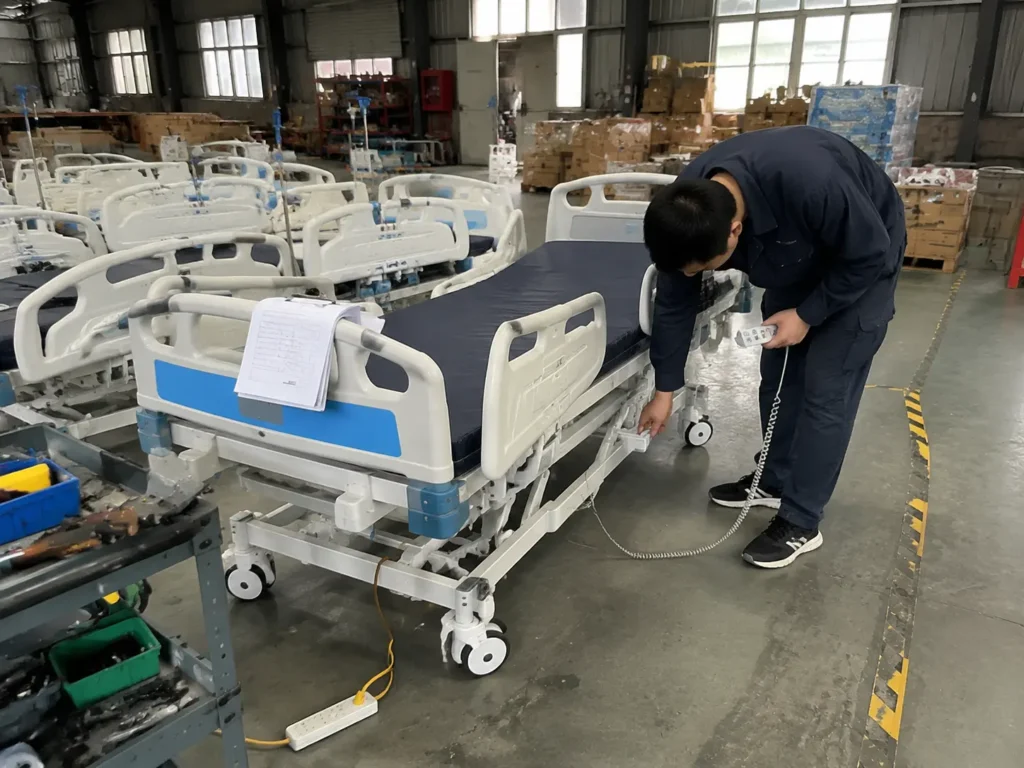
For hospitals, distributors, and procurement teams around the world, sourcing electric hospital beds directly from a specialized Chinese manufacturer is an increasingly attractive option — it offers strong cost advantages, customization flexibility, and the ability to build a long-term supply relationship. This guide is written for international buyers who import electric hospital beds. It walks you through product types, certifications, customization, pricing and payment terms, shipping, quality control, and after-sales support, so you can source with confidence.
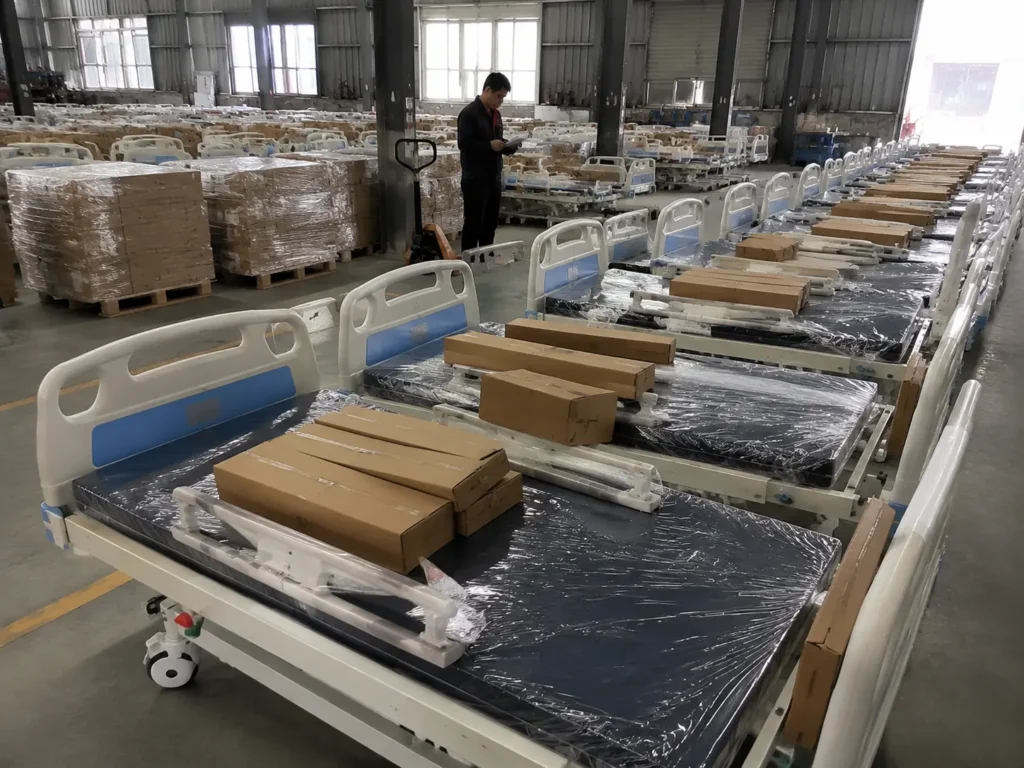
- Why Source Electric Hospital Beds from a Manufacturer Directly
Buying from a factory rather than a middleman changes the whole picture for importers:
Better pricing — direct factory supply removes intermediary markups, improving your margin or allowing more competitive end pricing.
Clearer responsibility — the manufacturer owns quality, delivery, and warranty, so responsibility is easier to trace.
Customization — factories can adapt specifications, packaging, and branding to your local market.
Long-term partnership — a reliable factory supports reorders, spare parts, and product-line expansion over time.
Note: This guide assumes a manufacturer-direct export model (no retail). Its goal is to help you evaluate and work with a factory, not to shop as an end consumer. - Types of Electric Hospital Beds for Export
Depending on your market and customer base, the main product lines to consider are:
Smart electric ICU bed — comprehensive functions, precise positioning, and integrated monitoring/IV/suction interfaces; suited to intensive care and high-end hospital projects.
Multi-function electric care bed — back-and-leg linkage and whole-bed lift; a balanced choice for general wards and care facilities.
Home electric care bed — easy operation and a compact footprint; popular for home care and family rehabilitation in many export markets.
Choosing the right mix for your market — and confirming which lines the factory can supply and customize — should be the first decision in your sourcing plan. - Key Certifications and Compliance
Before ordering, confirm which certifications and standards apply to your destination market. Common requirements for medical beds include:
CE marking — required for medical devices sold in the EU.
FDA registration — applicable for devices entering the U.S. market.
ISO 13485 — the quality management system standard for medical devices, a strong signal of manufacturing discipline.
IEC 60601 — the international safety standard for medical electrical equipment, often relevant for electrical beds.
Regional certifications — check local registration or import requirements in your country, as they vary by market.
Tip: Ask the manufacturer for copies of certificates and verify their validity and coverage before committing. A factory that holds relevant quality and safety certifications is far less likely to cause import or compliance delays. - Customization: OEM, ODM, MOQ, and Samples
One of the main advantages of working with a factory is customization. Understand the options and thresholds:
OEM (private label) — your brand name, logo, and packaging applied to the manufacturer’s standard models.
ODM (design customization) — modifications to specs, dimensions, functions, or features based on your market needs.
Minimum order quantity (MOQ) — confirm the MOQ for each model, and whether mixed orders are allowed.
Samples — request samples or trial units to verify quality and compliance before full production.
Lead time for customization — clarify how long tooling, prototypes, and approval take before mass production. - Pricing, MOQ, and Payment Terms
International purchasing is as much about trade terms as about unit price:
Understand the quoted price basis — clarify whether quotes are EXW, FOB, CIF, or DDP, and what is included (packaging, testing, documentation).
Quantity-based pricing — larger orders usually improve unit pricing; ask for a tiered price list.
Payment terms — common arrangements include T/T (often 30% deposit with balance before shipment) and L/C; confirm what your factory supports.
Hidden costs — account for freight, insurance, customs, and local certification when comparing costs.
Price note: Unit price alone is not the whole picture. Compare total landed cost and the factory’s reliability, not just the lowest quote. - Lead Time, Shipping, and Import Logistics
Plan the supply chain well in advance:
Production lead time — confirm standard production time and how it changes with order size or customization.
Shipping options — sea freight is common for bulk medical beds; air freight may suit samples or urgent orders. Confirm the incoterms and who arranges shipping.
Packaging for transit — ensure beds are packaged for overseas handling to avoid damage in transit.
Documentation — confirm the factory can provide export documents, certificates, and any needed paperwork for customs clearance in your country. - Quality Control and Inspection
Protecting quality across borders requires structured checks:
Pre-production — approve samples and technical specifications before mass production.
During production — agree on inspection points, especially for materials and key electrical components.
Pre-shipment inspection — arrange for a sample check or third-party inspection before dispatch, with clear acceptance criteria.
Documented QC reports — request inspection reports and test certificates as part of your records. - Warranty and After-Sales Support
Because your market is overseas, after-sales support must be planned carefully:
Warranty terms — confirm the warranty period for the whole bed and core components such as motors, and what it covers.
Spare parts — check the availability of spare parts and how they can be shipped for repairs.
Technical support — confirm remote support, manuals, and training materials in your language.
Service response — clarify the response process for quality issues and how claims are handled. - How to Choose a Reliable Export Manufacturer
Use a structured checklist when evaluating a factory:
Verify certifications and their validity.
Confirm the factory is a producer, not just a trading intermediary, and assess capacity.
Review export experience and references from buyers in your region or similar markets.
Confirm MOQ, lead time, payment terms, and after-sales process in writing.
Where possible, arrange factory audit or video inspection before a large order. - Frequently Asked Questions (FAQ)
- Q1: Why source electric hospital beds directly from a Chinese manufacturer?
- Direct factory supply removes intermediary markups, gives you better pricing and clearer quality/warranty responsibility, and enables OEM/ODM customization for your local market.
- Q2: What certifications should an electric hospital bed have for export?
- It depends on the destination market. Common requirements include CE marking for the EU, FDA registration for the U.S., and ISO 13485 / IEC 60601 as quality and safety benchmarks. Always confirm local import requirements.
- Q3: What are typical MOQs and payment terms?
- MOQ and payment terms vary by factory and model. Payment is commonly T/T (often a deposit with the balance before shipment) or L/C. Confirm MOQ, mixed-order
- flexibility, and incoterms (EXW/FOB/CIF/DDP) with the supplier.
- Q4: How do I protect quality when importing from overseas?
- Approve samples before production, agree on inspection points, arrange pre-shipment inspection with clear acceptance criteria, and request documented QC reports and certificates.