
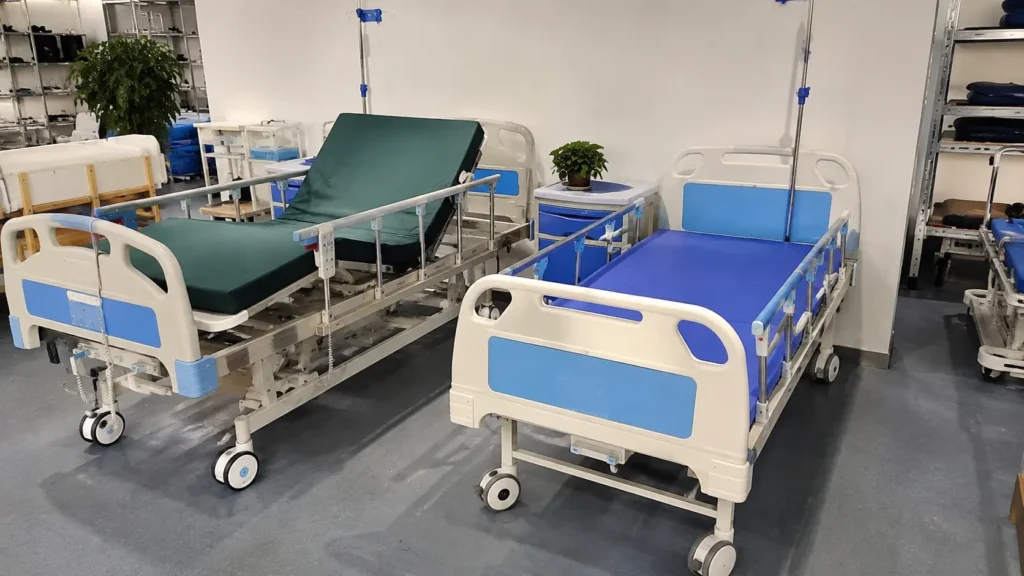
The main types of hospital beds are manual beds, semi-electric beds, full-electric beds, ICU beds, nursing beds, home-care beds, pediatric beds and bariatric beds. The right choice depends on the care setting, required movements, patient group, staff workflow, electrical availability, safe working load, accessories and purchasing budget—not simply on the number of functions.
This guide gives hospital procurement teams, care facilities, distributors and medical equipment importers a clear framework for comparing bed categories and preparing a model-specific RFQ.
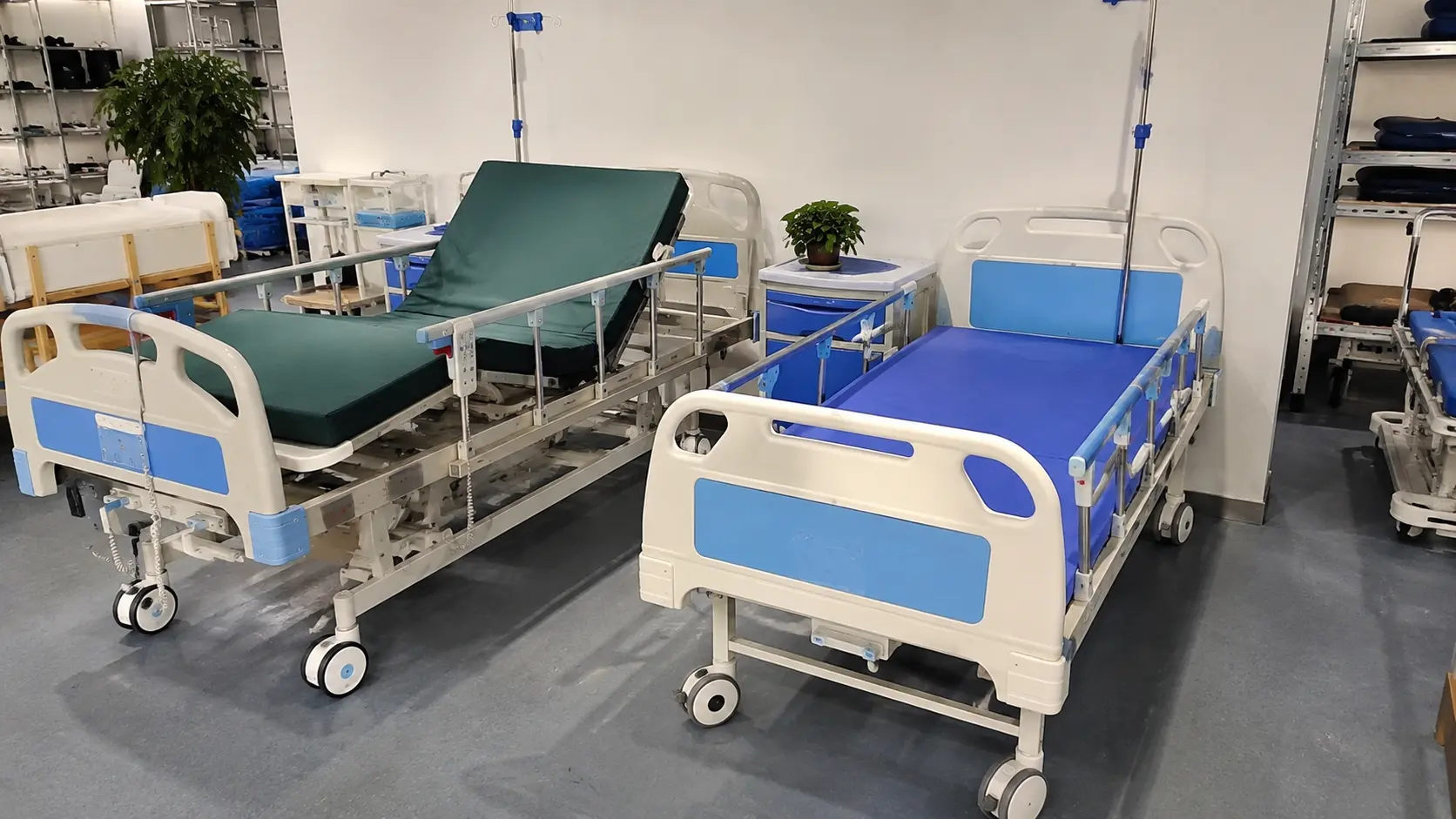
Types of Hospital Beds Compared
| Bed type | Typical adjustment method | Common setting | Primary buying consideration |
|---|---|---|---|
| Manual hospital bed | Hand cranks | General wards, clinics, projects with limited power | Function count, staff workload and crank durability |
| Semi-electric hospital bed | Motorized positioning plus manual height or another manual function | Home care and selected general-care settings | Which functions are powered and which remain manual |
| Full-electric hospital bed | Electric motors for main movements | Hospitals, rehabilitation and higher-use care settings | Control system, voltage, backup and maintenance support |
| ICU bed | Multi-motor electric system | Intensive and critical care | Required clinical workflow functions and accessories |
| Nursing bed | Manual or electric | Nursing homes and long-term care | Low height, resident transfers and caregiver workflow |
| Home-care bed | Manual, semi-electric or full-electric | Private homes and home-care distribution | Room access, assembly, user controls and after-sales service |
| Pediatric bed or crib | Manual or electric, model-specific | Pediatric wards | Patient age group, enclosure and applicable requirements |
| Bariatric bed | Manual or electric, usually model-specific | Hospital or long-term care | Complete-system load, usable width and transport access |
The names above describe broad categories, not universal specifications. Two suppliers may both offer a “five-function bed” while using different deck sizes, motor systems, rail designs, controls and included accessories. Buyers should compare written specifications line by line.
1. Manual Hospital Beds
Manual beds use hand cranks to adjust sections of the mattress platform. A two-crank model commonly provides backrest and leg or knee positioning. A three-crank model may add height adjustment, but the exact function of each crank must be confirmed from the supplier.
Manual beds can suit general wards, smaller clinics, emergency-preparedness inventory and markets where power availability or electrical servicing is a concern. They often have a lower initial price and fewer powered components, but staff must operate the cranks. That matters when beds are adjusted frequently or staffing resources are limited.
Buyers should check crank placement, folding mechanism, effort required, deck movement, caster braking, side rails and the availability of replacement mechanical components. A manual model should not be selected only because it is cheaper; the expected adjustment frequency and caregiver workload belong in the decision.
For detailed configuration differences, review the manual hospital bed 2 crank vs 3 crank guide.
2. Semi-Electric and Full-Electric Hospital Beds
Semi-electric beds
A semi-electric bed combines powered and manual adjustments. For example, backrest and knee positioning may be motorized while height remains manual. The term does not guarantee a specific function arrangement, so an RFQ should list every required movement and identify whether it must be electric or manual.
This category can provide powered everyday positioning at a lower cost than a fully powered system. However, it still requires electrical components and a manual workflow for the remaining adjustment. Buyers should confirm whether this mixed design actually fits local care routines.
Full-electric beds
Full-electric beds use motors for their main adjustments, usually controlled by a handset, nurse panel or both. Depending on the model, movements may include backrest, knee section, bed height and tilt positions. More advanced functions should be purchased only when the intended setting can use, maintain and support them.
Check motor quantity, control layout, lockout options, input voltage, plug type, battery availability, cable routing and replacement-part support. Ask what happens if power is interrupted and which emergency or manual release features apply to the chosen model.
If procurement teams are deciding between operating methods, our electric vs manual hospital bed comparison provides a focused workflow and cost analysis.

3. ICU and Critical-Care Beds
ICU beds are multi-function systems intended to support demanding critical-care workflows. Depending on the model and tender, they may include electric height and deck adjustment, multiple control locations, central braking, battery backup, removable boards, accessory mounting points and additional positioning features.
Not every hospital needs the highest-function configuration in every ward. ICU bed procurement should start with the facility’s required workflow and tender specification. A feature that is useful in critical care may add cost, maintenance needs and packing volume without providing value in a general ward.
Ask for:
- Exact movement ranges and control locations
- Safe working load and bed weight
- Overall and mattress-platform dimensions
- Brake and steering configuration
- Battery, power input and cable management
- Side-rail design and accessory mounting points
- Included mattress and optional therapy-surface compatibility
- Training, spare parts and documentation support
Use the ICU bed specifications buying guide when preparing a technical comparison sheet.
4. Nursing and Long-Term-Care Beds
Nursing beds are designed around repeated daily care, resident comfort, transfers and caregiver access. They may be manual or electric and may offer lower height, split rails, back and knee adjustment, easy-clean boards and compatibility with lifting or overbed-table accessories.
Low height is an important planning factor, but the quoted minimum height should be interpreted together with mattress thickness and caster configuration. A thick mattress changes the final transfer height and the effective height of the side rails.
Facilities should evaluate room size, flooring, doorway access, cleaning routines and staff training. If many beds will be deployed across several buildings, standardizing controls and spare parts can be more valuable than adding a rarely used function.
For long-term-care selection, see the nursing bed buying guide.
5. Home-Care Hospital Beds
Home-care beds bring medical-style positioning into residential environments. They may be manual, semi-electric or full-electric. Selection must consider the user’s care needs as well as delivery through doors, stairs and elevators, on-site assembly, floor protection, electrical outlets and the ability of caregivers to operate the controls.
A distributor should define clear packages—for example, frame plus mattress and rails—rather than allowing incompatible components to be mixed. Packaging size and component weight matter because home delivery may involve small vehicles and limited installation space.
Domestic furniture mattresses should not be assumed to fit an articulated care bed. Confirm platform size, mattress thickness, side-rail relationship and the way the mattress bends. Our article on hospital bed mattress size explains these checks.
6. Pediatric, Bariatric and Other Specialty Beds
Pediatric beds
Pediatric beds and medical cribs are selected for a defined age or patient group and use model-specific enclosure, rail and mattress systems. Adult-bed assumptions should not be transferred to pediatric purchasing. Buyers need the destination market’s requirements, the facility’s clinical specification and the manufacturer’s approved configuration.
Bariatric beds
Bariatric beds provide wider platforms and higher load capability than standard adult beds. Verify the complete-system safe working load, not only the capacity of the frame. The mattress, rails, casters, extension components and accessories must all suit the quoted configuration.
Room access is also critical. Measure doors, elevators, turning areas and transport routes using the overall bed width—not the mattress width. Wider equipment can be appropriate for the patient group yet difficult to deploy if building access was not surveyed.
Delivery, birthing and examination beds
Some healthcare equipment is called a bed but belongs to a different product category. Delivery beds, birthing beds, stretchers and examination couches have different functions and purchasing criteria. Buyers should not group them into a general ward-bed quotation without separate specifications.
How Buyers Should Choose the Right Hospital Bed Type
- Define the care environment. State whether the beds are for ICU, general ward, clinic, nursing home, rehabilitation or home care.
- Define the patient group. Include adult, pediatric, bariatric, elderly-care or other project-specific requirements.
- List essential movements. Specify backrest, knee, height and tilt requirements rather than asking only for a function count.
- Assess staff workflow. Estimate adjustment frequency, transfer routines, cleaning, transport and maintenance capability.
- Confirm dimensions and load. Request overall size, platform size, height range, bed weight and safe working load.
- Select the mattress as part of the system. Match its size and thickness to the deck and side rails.
- List accessories. State which items are required per bed and which are shared by a ward.
- Check electrical details. For powered beds, confirm voltage, plug, battery, controls and replacement components.
- Review documentation. Give the supplier the destination country and required tender, import or registration documents before order.
- Approve a sample. For volume procurement, inspect one complete model and accessory package before mass production.
Haoshangjia Medical offers a range of hospital beds for institutional and distribution buyers. Final functions, materials, documentation and included accessories should always be confirmed by model.
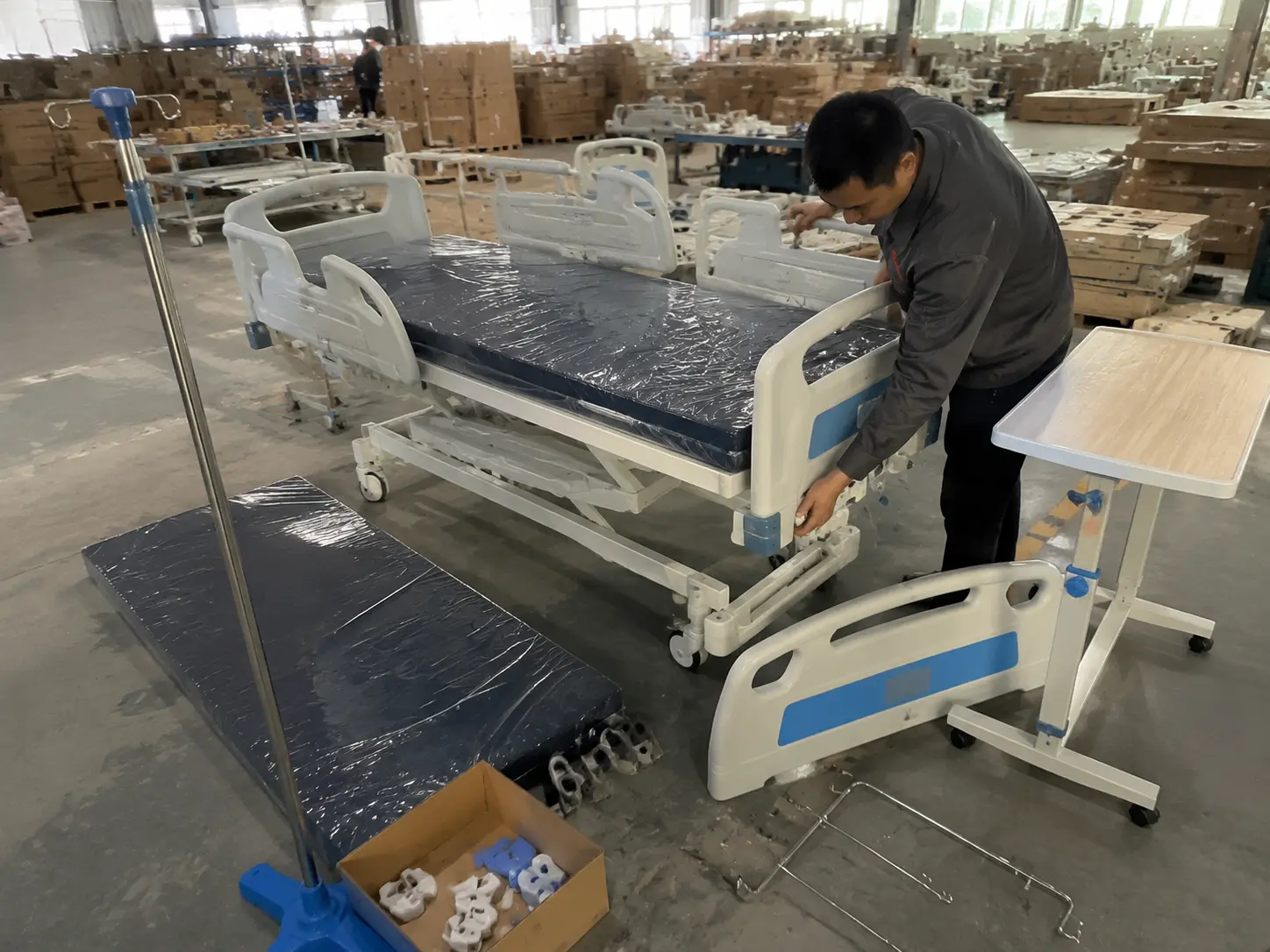
Hospital Bed Procurement Scenarios
Scenario 1: General hospital expansion
A hospital may use different configurations by department: full-electric or advanced beds for high-acuity areas, simpler electric beds for selected wards and manual beds for lower-adjustment settings. The buyer should create a bed schedule by department instead of applying one model to the entire facility.
Scenario 2: Nursing-home standardization
A nursing-home group may benefit from one electric nursing-bed platform across multiple sites. Standard controls, mattresses and spare parts simplify staff training and service. A smaller quantity of special-width or extended models can be listed as exceptions.
Scenario 3: Distributor product portfolio
A distributor might begin with three clearly separated offers: a value manual ward bed, a general electric bed and a home-care package. Each should have a fixed standard configuration and a controlled optional-accessory list. This is easier to sell and support than many overlapping models.
Scenario 4: Tender with a limited budget
Separate mandatory functions from preferred functions. Compare total landed and ownership factors—not only unit price—including mattress, accessories, spare parts, freight, installation and local service. If a function is removed to meet budget, document how that affects daily workflow.
Hospital Bed RFQ Checklist
- Facility type and department
- Bed category and quantity by model
- Required manual and electric movements
- Overall dimensions and mattress-platform dimensions
- Height range and safe working load
- Mattress size, thickness and surface requirement
- Side-rail, headboard and footboard configuration
- Caster diameter, brake and steering requirements
- IV poles, drainage hooks, tables and other accessories
- Voltage, frequency, plug and battery requirement
- Materials, color and OEM branding
- Spare-parts and training requirements
- Destination country and required documentation
- Quantity, destination port and delivery schedule
- Sample or pre-shipment inspection plan
A complete RFQ makes quotations easier to compare. It also prevents a low base-bed price from hiding the later cost of mattresses, accessories or destination-specific electrical changes.
Types of Hospital Beds FAQ
What are the main types of hospital beds?
The main categories are manual, semi-electric, full-electric, ICU, nursing, home-care, pediatric and bariatric beds. Some healthcare facilities also purchase specialty delivery, examination and transport equipment under separate specifications.
What is the difference between an electric bed and an ICU bed?
An electric bed describes its powered adjustment method. An ICU bed is designed around critical-care workflows and may include more controls, positioning options, braking features and accessory interfaces. Not every electric bed is an ICU bed.
How many functions should a hospital bed have?
There is no ideal number for every setting. Buyers should list required movements and workflow needs. A three-function model may be sufficient for one ward, while another department may need a more advanced configuration.
Are manual hospital beds still suitable for hospitals?
They can be suitable where adjustment frequency, staff workflow, budget and power conditions support manual operation. The decision should consider ongoing caregiver effort, not only the lower initial price.
Which hospital bed is best for a nursing home?
A nursing or long-term-care bed with appropriate height, mattress, rails and controls is often considered, but the correct configuration depends on resident needs, transfer routines, room access and staffing.
Can one bed type serve every hospital department?
Usually not efficiently. Departments have different patient groups and workflows. A bed schedule by department allows standardization where practical while preserving specialized configurations for ICU, pediatric and bariatric care.
Request a Hospital Bed Selection Recommendation
Haoshangjia Medical is a China hospital bed manufacturer and supplier serving hospitals, nursing homes, clinics, rehabilitation centers and medical equipment distributors. Send the facility type, required functions, quantities, destination country, voltage, accessories and documentation needs for a model-specific discussion.