
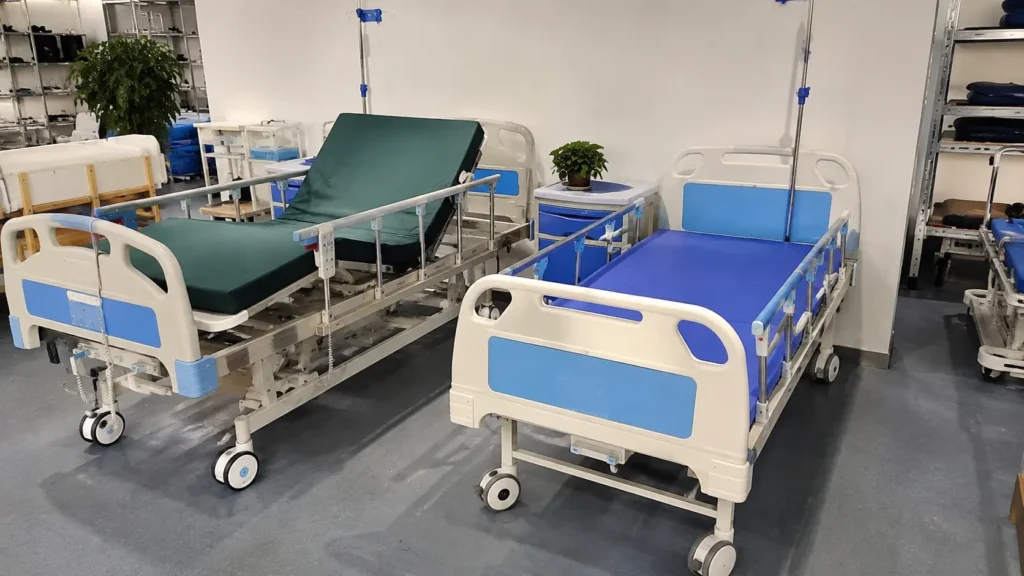
To choose a hospital bed supplier, verify that the company can translate your use case into an exact model specification, provide comparable pricing, support export and destination documents, control accessories and packing, and maintain clear responsibility from sample approval through after-sales service. Do not select on unit price alone. The best supplier is the one that reduces total procurement risk across product fit, communication, delivery, documentation, and replacement parts.
This guide explains how to choose a hospital bed supplier for distributors, importers, hospital projects, nursing homes, clinics, and rehabilitation facilities. It focuses on the supplier relationship and purchase process, rather than factory production auditing.
1. Define the Supplier Role You Need
A hospital bed supplier may be a manufacturer, an export company, a sourcing company, or a distributor. The label alone does not determine whether the company is suitable. Buyers should define the work the supplier must perform and then verify capability against that role.
For a single-model repeat order, direct production capability and consistency may be the priority. For a mixed hospital project, the buyer may need one supplier to coordinate several bed categories, accessories, documents, and shipment schedules. For a private-label program, product selection, artwork control, manuals, packaging, and spare-parts continuity become especially important.
Ask the supplier to state clearly:
- Whether it manufactures the quoted model or sources it from another producer
- Which product and quality checks it directly controls
- Who issues the quotation, invoice, packing list, and warranty
- Who is responsible for specifications, production follow-up, inspection, and claims
- Whether mixed models and accessories can be consolidated
If factory identity is central to your project, use the separate guide on how to choose a hospital bed manufacturer. The article on hospital bed manufacturer vs supplier also explains when each sourcing structure may fit.
2. Test Product and Application Knowledge
A competent supplier should ask about the care setting, quantity, required movements, destination market, electrical configuration, accessories, documentation, and delivery deadline before recommending a model. A supplier that sends the same generic bed to every buyer creates specification risk.
| Buyer Setting | Likely Starting Category | Questions the Supplier Should Ask |
|---|---|---|
| General hospital ward | Manual or electric hospital bed | Adjustment functions, ward workflow, voltage, mattress, rails, and accessories |
| ICU project | ICU bed | Required movements, controls, rails, casters, accessories, and project specification |
| Nursing home | Nursing bed | Resident mobility, caregiver routine, height range, mattress, and cleaning |
| Home-care distribution | Home care hospital bed | Residential access, assembly, appearance, electrical needs, and local service |
| Clinic or budget project | Manual hospital bed | Essential functions, operating environment, quantity, and maintenance capacity |
A strong response should connect each recommendation to a stated requirement. Buyers can compare available categories through the hospital bed supplier hub before preparing the RFQ.

3. Require a Complete, Comparable Quotation
Never compare only the product name and unit price. Two quotations for a “three-function electric hospital bed” may include different motors, rails, casters, boards, mattresses, accessories, packing, warranties, and trade terms.
Require the quotation to show:
- Exact model number and a written list of every movement
- Platform dimensions, overall dimensions, and height range
- Safe working load and any stated user-weight limit
- Frame, platform, boards, rails, casters, and brake configuration
- Motor, actuator, control box, handset, voltage, frequency, and plug for electric beds
- Standard accessories, optional accessories, and exclusions
- Mattress specification or an explicit statement that it is excluded
- MOQ, unit price, Incoterm, packing, lead time, warranty, and quote validity
Create a comparison sheet with one row per requirement and one column per supplier. Mark unanswered items rather than assuming that they are included. A complete offer may be lower risk than a cheaper offer that leaves key components undefined.
4. Verify the Company and Product Evidence
Verification should match the value and risk of the order. Start with company identity, business contact details, invoice entity, payment beneficiary, product model, and the supplier’s stated role. Material inconsistencies should be resolved before a deposit.
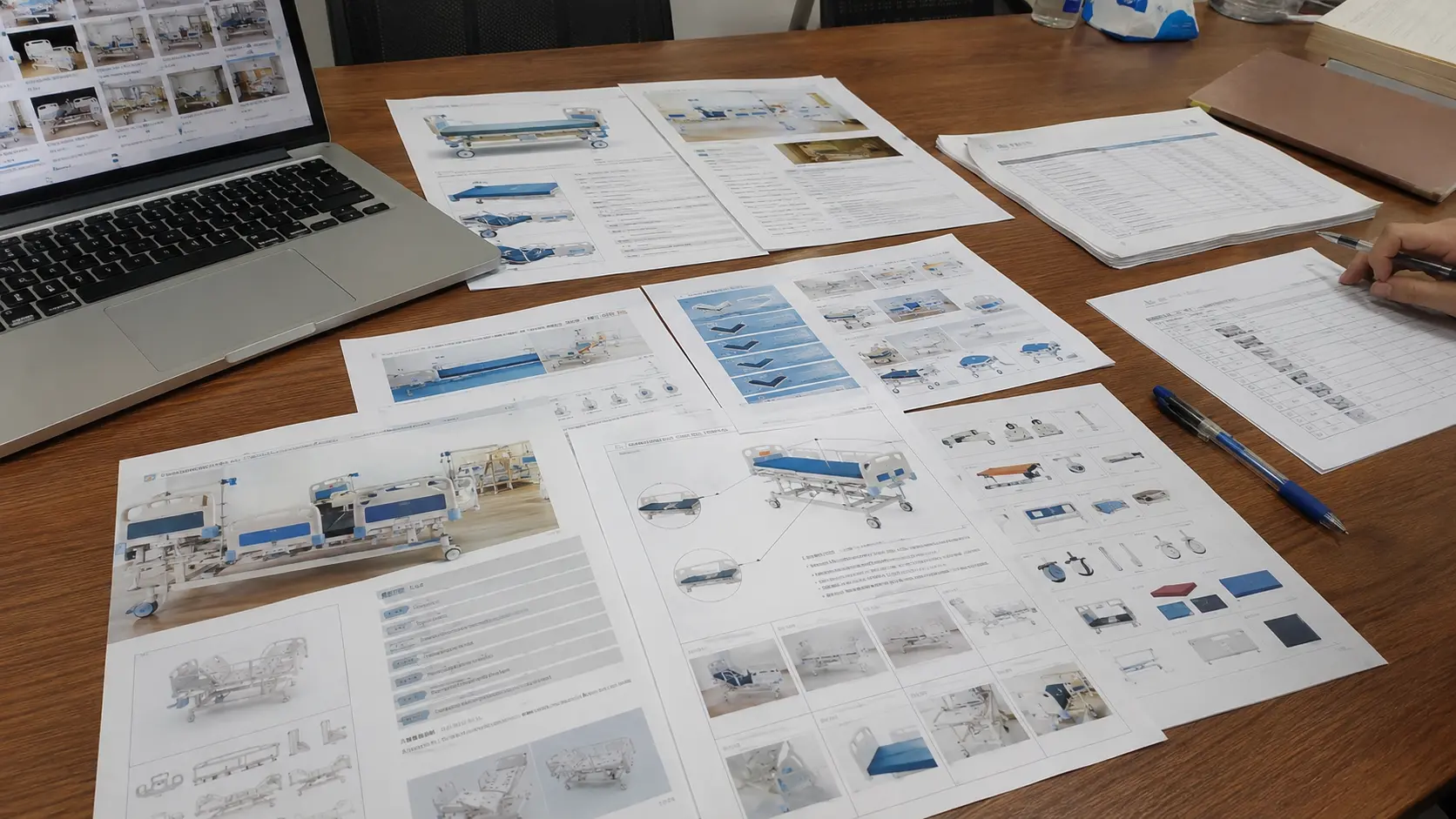
Useful product evidence can include current specification sheets, model photos and videos, labels, packaging examples, inspection records, user manuals, and a live video review of the proposed model. For larger orders, buyers may arrange a sample, remote inspection, or independent pre-shipment inspection.
Do not treat a polished website, marketplace badge, or company-level certificate as proof of every product claim. Confirm that documents and evidence relate to the exact supplier, model, and transaction. Haoshangjia Medical presents its company and sourcing position on the About Us page, but order-specific facts should still be written into the quotation and purchase documents.
5. Confirm Export and Destination Documents
Document requirements should be discussed before the order, not after production. The importer or local registration agent should first define what is required for customs, tender review, registration, internal procurement, and end-user delivery.
Ask the supplier which of the following can be prepared for the quoted model:
- Commercial invoice and packing list
- Model-specific specification sheet
- User, assembly, cleaning, or maintenance instructions
- Product and packaging labels
- Available conformity-related documents
- Country-of-origin or shipment documents when applicable
- Files requested by the buyer’s tender or registration team
Availability can vary by product model and destination. A responsible supplier should identify what is available and what requires confirmation. Avoid accepting claims of guaranteed compliance in every country.
6. Use Samples and Written Approval
A sample is useful when launching a new model, approving an OEM configuration, or placing a large repeatable order. Agree in advance whether the sample is production-standard, which options it includes, who pays freight, and whether sample cost can be credited to a bulk order.
Record sample approval with photos, model number, specifications, labels, accessories, colour, packaging, and any approved corrections. The bulk order should reference this approved configuration. Verbal approval is not enough when multiple people or suppliers are involved.
If a physical sample is impractical, use a structured remote review. Ask the supplier to demonstrate each movement, controls, rails, brakes, boards, accessories, labels, dimensions, and packing. Remote evidence does not replace every form of inspection, but it can reveal misunderstandings before production.
7. Check MOQ, Lead Time, Payment, and Incoterms
Commercial terms should match the actual project. Ask for MOQ by model, mixed-model order policy, sample lead time, production lead time, quote validity, payment stages, and the event that starts the lead-time clock. Clarify whether final artwork and specification approval are required before production begins.
Compare Incoterms carefully. An EXW, FOB, CIF, or other quotation allocates costs and responsibilities differently. State the named place or destination port and confirm which local charges, insurance, customs clearance, duties, and delivery services are excluded. Buyers should use their freight forwarder or trade adviser when necessary.
Do not use a rushed payment schedule to compensate for incomplete specifications. Before deposit, confirm the contracting entity, beneficiary, model, quantity, price, configuration, delivery term, lead time, documents, and inspection arrangement in writing.
8. Review Packing and Logistics
Hospital beds are bulky and contain surfaces, boards, rails, casters, mechanical parts, and sometimes electrical components that require protection. Ask whether beds ship assembled, semi-assembled, or disassembled and request package quantity, dimensions, gross weight, and loading estimate.
Confirm how loose accessories are identified and packed, how surfaces and electrical parts are protected, and whether carton marks or OEM labels are required. For mixed-model shipments, use a packing list that makes each model and accessory easy to identify at destination.
Container-loading estimates should state the assumptions used. Actual quantities depend on model dimensions, packing method, accessories, container limits, and safe loading practice. The guide on how many hospital beds fit in a 40HQ container explains why a model-specific loading plan is necessary.
9. Evaluate Warranty and Spare Parts
Ask for written warranty scope, period, exclusions, claim procedure, evidence required, response time, and freight responsibility. “One-year warranty” is incomplete if it does not identify covered components and how a claim is resolved.
For electric beds, confirm the availability and identification of motors, actuators, control boxes, handsets, and cables. For all beds, discuss casters, brakes, rails, boards, cranks, fasteners, and model-specific accessories. Request a recommended spare-parts package based on order quantity and expected service conditions.
Distributors should also ask for assembly guidance, parts diagrams where available, fault-reporting steps, and training material. A supplier that supports part-level replacement can reduce downtime and avoid unnecessary full-product returns.
10. Apply the Checks to Buyer Scenarios
Hospital project buyer
Use the tender or room schedule to create model quantities, configurations, accessories, and document requirements. Require a compliance table that shows whether each requested item is included, optional, or unavailable.
Medical equipment distributor
Prioritize model continuity, OEM control, packaging, manuals, spare parts, and after-sales communication. Start with a focused range that the local team can demonstrate and service.
Nursing home group
Define resident categories and caregiver workflows, then standardize most rooms around a manageable number of bed configurations. Confirm cleaning, maintenance, and replacement-part plans.
Clinic or rehabilitation buyer
Separate essential functions from optional upgrades. Confirm room dimensions, transfer equipment, budget, delivery timing, and whether mixed equipment can be coordinated without weakening hospital-bed specifications.
Hospital Bed Supplier Comparison Scorecard
| Area | Suggested Weight | Evidence to Review |
|---|---|---|
| Product and application fit | 20% | Model recommendation linked to written requirements |
| Specification completeness | 20% | Model sheet, drawings, configuration, included items |
| Company and transaction clarity | 10% | Identity, supplier role, invoice and payment entity |
| Documents and compliance support | 15% | Model-specific available documents and buyer requirement list |
| Price and commercial terms | 15% | Comparable delivered configuration, MOQ, lead time, Incoterm |
| Quality, sample, and inspection plan | 10% | Approval record and inspection method |
| Warranty, parts, and communication | 10% | Written process, parts list, response quality |
Adjust the weights for your project. Score only from evidence, and record major risks separately. A supplier with a high average score may still be unsuitable if a mandatory document or function is missing.
Hospital Bed Supplier RFQ Checklist
- Buyer company, destination country, destination port, and care setting
- Bed type, quantity by model, and expected repeat demand
- Required movements, ranges, dimensions, and safe working load
- Rails, casters, brakes, boards, mattress, and accessories
- Voltage, frequency, plug, controls, and electrical options
- OEM logo, labels, manuals, colour, and carton requirements
- Required commercial, tender, import, or registration documents
- Sample and approval requirements
- MOQ, price, Incoterm, named place or port, and payment terms
- Production lead time, inspection, packing, and loading data
- Warranty, claim process, spare parts, and training support
Frequently Asked Questions
What is the first thing to check when choosing a hospital bed supplier?
Check whether the supplier can turn your care setting and purchase requirements into a complete written model specification. Without that, price and document comparisons are unreliable.
Should I choose the lowest hospital bed price?
Not automatically. Compare the same configuration, accessories, packing, warranty, documents, and Incoterm. A low price may exclude essential items or transfer more risk to the buyer.
Is a manufacturer always better than a trading supplier?
No. The right structure depends on the order. Direct production may matter for a repeat model, while a capable supplier may add value in mixed sourcing, export coordination, and consolidated service. Verify responsibility and control.
What documents should I request?
Request the exact model specification, invoice and packing documents, manuals, labels, and any model-specific conformity files required by your importer, tender team, or registration agent.
How can I reduce risk before paying a deposit?
Verify company and beneficiary information, finalize the specification and accessories, confirm documents and delivery terms, approve a sample or remote review when appropriate, and record everything in writing.
What should be included in after-sales support?
Ask for written warranty coverage, claim steps, replacement-part identification, recommended spare parts, assembly guidance, and a clear communication channel.
Request a Comparable Hospital Bed Quotation
Haoshangjia Medical is a China hospital bed manufacturer and supplier serving hospitals, nursing homes, clinics, rehabilitation centers, home-care distributors, and medical equipment importers. Product configuration and available documentation should be confirmed for each model and destination.
Request a hospital bed quote with your quantity, bed type, destination country and port, voltage, accessories, OEM requirements, documents, and preferred trade term. Ask for a model-specific specification, included and optional items, packing data, lead time, warranty, and spare-parts proposal.